

Winter Sale Flat 65% Limited Time Discount offer - Ends in 0d 00h 00m 00s - Coupon code: netdisc

WGU Financial-Management WGU Financial Management VBC1 Exam Practice Test

WGU Financial Management VBC1 Questions and Answers

Testing Engine

  • Product Type: Testing Engine
$43.75  $124.99

PDF Study Guide

  • Product Type: PDF Study Guide
$38.5  $109.99
Question 1

Why might a firm use a combination of methods to calculate the cost of common equity?

Options:

A.

To achieve a more accurate and comprehensive estimate

B.

To focus exclusively on dividend policies

C.

To comply with regulatory requirements

D.

To account for one method being significantly more complex

Question 2

Rusty RoboTech, a robotics technology company, has provided the following financial information for the year 20X3:

• Sales Revenue: $500,000

• Net Income: $50,000

• Dividend Payout: 40% of Net Income

• Total Assets at the beginning of 20X3: $300,000

• Total Liabilities at the beginning of 20X3: $150,000

• Equity at the beginning of 20X3: $150,000

• Historical Cash-to-Sales Ratio: 5%

• Accounts Receivable-to-Sales Ratio: 15%

• Inventory-to-Sales Ratio: 25%

• Cost of Goods Sold-to-Sales Ratio: 43%

For the year 20X4, Rusty RoboTech projects a 20% increase in sales revenue. Other ratios and the dividend policy are expected to remain the same.

What is the projected inventory value for Rusty RoboTech at the beginning of 20X4?

Options:

A.

$120,000

B.

$130,000

C.

$140,000

D.

$150,000

Question 3

What is a primary goal of managing accounts receivable through credit policies?

Options:

A.

To eliminate accounts receivable entirely

B.

To transition all sales to cash-only transactions

C.

To maximize sales regardless of cash flow impact

D.

To balance customer convenience with the firm’s cash flow needs

Question 4

What distinguishes free cash flow to equity (FCFE) from free cash flow to the firm (FCFF)?

Options:

A.

FCFE is distributable only to debt holders, whereas FCFF is distributable only to equity holders.

B.

FCFE includes depreciation, amortization, and other non-cash expenses, while FCFF does not.

C.

FCFE measures cash distributable to equity holders after all obligations are met, including debt payments.

D.

FCFE represents the total cash flow from operations that is available at the end of the period.

Question 5

A start-up company's lender is concerned that the company may not be able to meet its financial obligations. It asks the company to provide it with information regarding its current assets and current liabilities.

Which information would the start-up company need to provide to the lender?

Options:

A.

Investments that the firm plans to hold for more than one year

B.

Obligations that require cash within the next year

C.

Long-term debt obligations payable to the bank

D.

Depreciation of equipment the firm uses for its daily operations

Question 6

What does a beta of less than 1 signify in the capital asset pricing model (CAPM)?

Options:

A.

The investment has higher risk than the market.

B.

The investment has lower risk than the market.

C.

The investment has a return that is independent of the market.

D.

The investment is risk-free.

Question 7

Ratios for Freedom Rock Bicycles are shown below, along with industry average ratios.
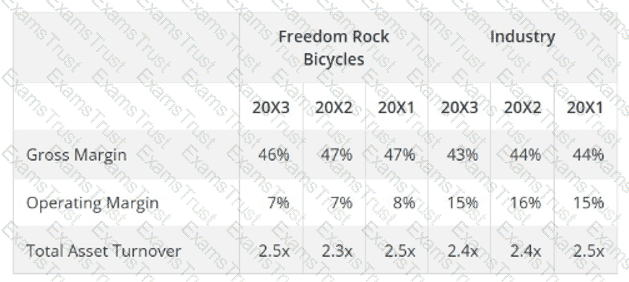
What are appropriate recommendations for Freedom Rock Bicycles based on this analysis?

Options:

A.

To increase production expenses and invest in more assets

B.

To maintain current operating expenses and reduce asset levels to be in line with the industry

C.

To reduce non-production expenses and evaluate the company’s fixed costs

D.

To focus solely on increasing gross margins to match industry levels

Question 8

To answer this question, refer to the cash flow worksheet and the internal rate of return (IRR) calculations. The hospital is only interested in accepting projects with an IRR that exceeds 11%. Assuming the hospital has sufficient capital for both projects and is willing to invest for up to 10 years, which project(s) would the hospital accept?

Options:

A.

Project A

B.

Both Project A and Project B

C.

Neither Project A nor Project B

D.

Project B

Question 9

How does asset tangibility affect a company’s capital structure?

Options:

A.

By influencing the company’s dividend payout ratio

B.

By influencing the company’s ability to secure debt financing

C.

By influencing the company’s ability to issue convertible bonds

D.

By influencing the company’s decision to enter new markets

Question 10

A stock has a dividend per share of $5 and is expected to grow at a constant rate of 3% indefinitely. The required rate of return is 9%.

What is the value of the stock?

Options:

A.

$57.22

B.

$85.83

C.

$100.50

D.

$171.67

Question 11

What is a benefit of a firm extending credit to customers in a competitive market?

Options:

A.

Immediate cash inflows from sales

B.

Decreased sales due to increased prices

C.

Increased sales to non-cash buyers

D.

Reduced customer base due to credit terms

Question 12

In the capital asset pricing model (CAPM), what does a beta (β) greater than 1 signify for a portfolio?

Options:

A.

The portfolio will always outperform the market.

B.

The portfolio has more risk than the market.

C.

The portfolio has less risk than the market.

D.

The portfolio is expected to move in the opposite direction of the market.

Question 13

What is a drawback of using the Gordon growth model for estimating the cost of common equity?

Options:

A.

It emphasizes short-term financial performance.

B.

It requires extensive market data analysis.

C.

It is too complex for general use.

D.

It applies only to companies with stable dividend policies.

Question 14

Why might tax expense on the income statement not reflect the actual taxes paid by a firm?

Options:

A.

Because there are differences between tax and accrual accounting rules

B.

Because tax expense is never an estimation and not based on real figures

C.

Because all tax expenses on the income statement accurately reflect taxes paid

D.

Because tax expenses are always deferred to the next fiscal year

Question 15

How does the global bond market impact the strategies of multinational corporations?

Options:

A.

By enhancing incentives to raise capital domestically

B.

By reducing the need for currency risk management

C.

By offering diverse financing options beyond domestic markets

D.

By ensuring fixed interest rates on all international loans

Question 16

According to the capital asset pricing model (CAPM), how is a stock with a beta of 1.0 expected to perform relative to the market?

Options:

A.

It will underperform the market.

B.

It will perform in line with the market.

C.

It will outperform the market.

D.

It will perform opposite of the market.

Question 17

A company has a return on assets (ROA) of 10% and total assets of $500 million.

What is its net income?

Options:

A.

$5 million

B.

$10 million

C.

$50 million

D.

$100 million