
Big Cyber Monday Sale Limited Time 70% Discount Offer - Ends in 0d 00h 00m 00s - Coupon code: 70special

Salesforce MuleSoft-Platform-Architect-I Salesforce Certified MuleSoft Platform Architect (Mule-Arch-201) Exam Practice Test

Salesforce Certified MuleSoft Platform Architect (Mule-Arch-201) Questions and Answers

Testing Engine

  • Product Type: Testing Engine
$37.5  $124.99

PDF Study Guide

  • Product Type: PDF Study Guide
$33  $109.99
Question 1

An API implementation is updated. When must the RAML definition of the API also be updated?

Options:

A.

When the API implementation changes the structure of the request or response messages

B.

When the API implementation changes from interacting with a legacy backend system deployed on-premises to a modern, cloud-based (SaaS) system

C.

When the API implementation is migrated from an older to a newer version of the Mule runtime

D.

When the API implementation is optimized to improve its average response time

Question 2

An established communications company is beginning its API-led connectivity journey, The company has been using a successful Enterprise Data Model for many years. The company has identified a self-service account management app as the first effort for API-led, and it has identified the following APIs.

Experience layer: Mobile Account Management EAPI, Browser Account Management EAPI

Process layer: Customer Lookup PAPI, Service Lookup PAPI, Account Lookup PAPI

System layer: Customer SAPI, Account SAPI, Product SAPI, Service SAPI

According to MuleSoft's API-led connectivity approach, which API would not be served by the Enterprise Data Model?

Options:

A.

Customer SAPI

B.

Customer Lookup PAPI

C.

Mobile Account Management EAPI

D.

Service SAPI

Question 3

When should idempotency be taken into account?

Options:

A.

When making requests to update currently locked entities

B.

When storing the results of s previous request for use in response to subsequent requests

C.

When sending concurrent update requests for the same entity

D.

When preventing duplicate processing from multiple sent requests

Question 4

What is true about API implementations when dealing with legal regulations that require all data processing to be performed within a certain jurisdiction (such as in the USA or the EU)?

Options:

A.

They must avoid using the Object Store as it depends on services deployed ONLY to the US East region

B.

They must use a Jurisdiction-local external messaging system such as Active MQ rather than Anypoint MQ

C.

They must te deployed to Anypoint Platform runtime planes that are managed by Anypoint Platform control planes, with both planes in the same Jurisdiction

D.

They must ensure ALL data is encrypted both in transit and at rest

Question 5

A circuit breaker strategy is planned in order to meet the goal of improved response time and demand on a downstream API.

* Circuit Open: More than 10 errors per minute for three minutes

* Circuit Half-Open: One error per minute

* Circuit Closed: Less than one error per minute for five minutes

Out of several proposals from the engineering team, which option will meet this goal?

Options:

A.

Create a custom policy that implements the circuit breaker and includes policy template expressions for the required settings

B.

Create Anypoint Monitoring alerts for Circuit Open/Closed configurations, and then implement a retry strategy for Circuit Half-Open configuration

C.

Add the Circuit Breaker policy to the API instance, and configure the required settings

D.

Implement the strategy in a Mule application, and provide the settings in the YAML configuration

Question 6

A Platform Architect inherits a legacy monolithic SOAP-based web service that performs a number of tasks, including showing all policies belonging to a client. The service connects to two back-end systems — a life-insurance administration system and a general-insurance administration system — and then queries for insurance policy information within each system, aggregates the results, and presents a SOAP-based response to a user interface (UI).

The architect wants to break up the monolithic web service to follow API-led conventions.

Which part of the service should be put into the process layer?

Options:

A.

Combining the insurance policy information from the administration systems

B.

Presenting the SOAP-based response to the UI

C.

Authenticating and maintaining connections to each of the back-end administration systems

D.

Querying the data from the administration systems

Question 7

Refer to the exhibit. An organization is running a Mule standalone runtime and has configured Active Directory as the Anypoint Platform external Identity Provider. The organization does not have budget for other system components.

What policy should be applied to all instances of APIs in the organization to most effecuvelyKestrict access to a specific group of internal users?

Options:

A.

Apply a basic authentication - LDAP policy; the internal Active Directory will be configured as the LDAP source for authenticating users

B.

Apply a client ID enforcement policy; the specific group of users will configure their client applications to use their specific client credentials

C.

Apply an IP whitelist policy; only the specific users' workstations will be in the whitelist

D.

Apply an OAuth 2.0 access token enforcement policy; the internal Active Directory will be configured as the OAuth server

Question 8

What is true about the technology architecture of Anypoint VPCs?

Options:

A.

The private IP address range of an Anypoint VPC is automatically chosen by CloudHub

B.

Traffic between Mule applications deployed to an Anypoint VPC and on-premises systems can stay within a private network

C.

Each CloudHub environment requires a separate Anypoint VPC

D.

VPC peering can be used to link the underlying AWS VPC to an on-premises (non AWS) private network

Question 9

What is true about where an API policy is defined in Anypoint Platform and how it is then applied to API instances?

Options:

A.

The API policy Is defined In Runtime Manager as part of the API deployment to a Mule runtime, and then ONLY applied to the specific API Instance

B.

The API policy Is defined In API Manager for a specific API Instance, and then ONLY applied to the specific API instance

C.

The API policy Is defined in API Manager and then automatically applied to ALL API instances

D.

The API policy is defined in API Manager, and then applied to ALL API instances in the specified environment

Question 10

An API has been updated in Anypoint exchange by its API producer from version 3.1.1 to 3.2.0 following accepted semantic versioning practices and the changes have been communicated via the APIs public portal. The API endpoint does NOT change in the new version. How should the developer of an API client respond to this change?

Options:

A.

The API producer should be requested to run the old version in parallel with the new one

B.

The API producer should be contacted to understand the change to existing functionality

C.

The API client code only needs to be changed if it needs to take advantage of the new features

D.

The API clients need to update the code on their side and need to do full regression

Question 11

A customer wants to host their MuleSoft applications in CloudHub 1.0, and these applications should be available at the domain

After creating a dedicated load balancer (DLB) called acme-dib-prod, which further action must the customer take to complete the configuration?

Options:

A.

Configure the DLB with a TLS certificate for api.acmecorp.com and create an A record for api.acmecorp.com to the public IP addresses associated with their DLB

B.

Configure the DLB with a TLS certificate for api.acmecorp.com and create a CNAME record from api.acmecorp.com to acme-dib-prod.|lb.anypointdns.net

C.

Configure the DLB with a TLS certificate for acme-dib-prod.Jb.anypointdns.net and create a CNAME record from api.acmecorp:com to acme-dlb-prod.lb.anypointdns.net

D.

Configure the DLB with a TLS certificate for aplacmecorp.com and create a CNAME record from api.aomecorp.com to acme-dib-prod.ei.cloubhub.io

Question 12

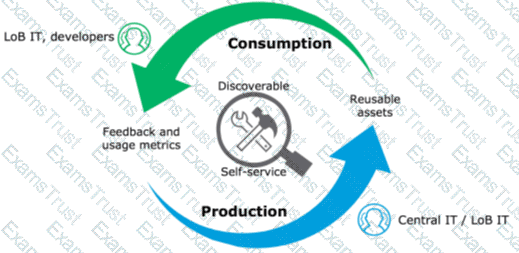
What are the major benefits of MuleSoft proposed IT Operating Model?

Options:

A.

1. Decrease the IT delivery gap2. Meet various business demands without increasing the IT capacity3. Focus on creation of reusable assets first. Upon finishing creation of all the possible assets then inform the LOBs in the organization to start using them

B.

1. Decrease the IT delivery gap2. Meet various business demands by increasing the IT capacity and forming various IT departments3. Make consumption of assets at the rate of production

C.

1. Decrease the IT delivery gap2. Meet various business demands without increasing the IT capacity3. Make consumption of assets at the rate of production

Question 13

An API is protected with a Client ID Enforcement policy and uses the default configuration. Access is requested for the client application to the API, and an approved

contract now exists between the client application and the API

How can a consumer of this API avoid a 401 error "Unauthorized or invalid client application credentials"?

Options:

A.

Send the obtained token as a header in every call

B.

Send the obtained: client_id and client_secret in the request body

C.

Send the obtained clent_id and clent_secret as URI parameters in every call

D.

Send the obtained clent_id and client_secret in the header of every API Request call

Question 14

A retail company with thousands of stores has an API to receive data about purchases and insert it into a single database. Each individual store sends a batch of purchase data to the API about every 30 minutes. The API implementation uses a database bulk insert command to submit all the purchase data to a database using a custom JDBC driver provided by a data analytics solution provider. The API implementation is deployed to a single CloudHub worker. The JDBC driver processes the data into a set of several temporary disk files on the CloudHub worker, and then the data is sent to an analytics engine using a proprietary protocol. This process usually takes less than a few minutes. Sometimes a request fails. In this case, the logs show a message from the JDBC driver indicating an out-of-file-space message. When the request is resubmitted, it is successful. What is the best way to try to resolve this throughput issue?

Options:

A.

se a CloudHub autoscaling policy to add CloudHub workers

B.

Use a CloudHub autoscaling policy to increase the size of the CloudHub worker

C.

Increase the size of the CloudHub worker(s)

D.

Increase the number of CloudHub workers

Question 15

A team is planning to enhance an Experience API specification, and they are following API-led connectivity design principles.

What is their motivation for enhancing the API?

Options:

A.

The primary API consumer wants certain kinds of endpoints changed from the Center for Enablement standard to the consumer system standard

B.

The underlying System API is updated to provide more detailed data for several heavily used resources

C.

An IP Allowlist policy is being added to the API instances in the Development and Staging environments

D.

A Canonical Data Model is being adopted that impacts several types of data included in the API

Question 16

A Rate Limiting policy is applied to an API implementation to protect the back-end system. Recently, there have been surges in demand that cause some API client

POST requests to the API implementation to be rejected with policy-related errors, causing delays and complications to the API clients.

How should the API policies that are applied to the API implementation be changed to reduce the frequency of errors returned to API clients, while still protecting the back-end

system?

Options:

A.

Keep the Rate Limiting policy and add 9 Client ID Enforcement policy

B.

Remove the Rate Limiting policy and add an HTTP Caching policy

C.

Remove the Rate Limiting policy and add a Spike Control policy

D.

Keep the Rate Limiting policy and add an SLA-based Spike Control policy

Question 17

Which of the following sequence is correct?

Options:

A.

API Client implementes logic to call an API >> API Consumer requests access to API >> API Implementation routes the request to >> API

B.

API Consumer requests access to API >> API Client implementes logic to call an API >> API routes the request to >> API Implementation

C.

API Consumer implementes logic to call an API >> API Client requests access to API >> API Implementation routes the request to >> API

D.

API Client implementes logic to call an API >> API Consumer requests access to API >> API routes the request to >> API Implementation

Question 18

Which component monitors APIs and endpoints at scheduled intervals, receives reports about whether tests pass or fail, and displays statistics about API and endpoint

performance?

Options:

A.

API Analytics

B.

Anypoint Monitoring dashboards

C.

APT Functional Monitoring

D.

Anypoint Runtime Manager alerts

Question 19

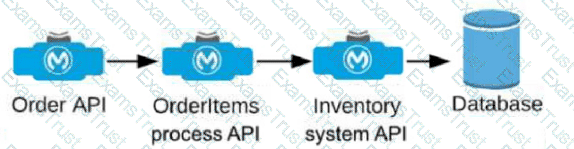
An Order API triggers a sequence of other API calls to look up details of an order's items in a back-end inventory database. The Order API calls the OrderItems process API, which calls the Inventory system API. The Inventory system API performs database operations in the back-end inventory database.

The network connection between the Inventory system API and the database is known to be unreliable and hang at unpredictable times.

Where should a two-second timeout be configured in the API processing sequence so that the Order API never waits more than two seconds for a response from the Orderltems process API?
Options:

A.

In the Orderltems process API implementation

B.

In the Order API implementation

C.

In the Inventory system API implementation

D.

In the inventory database

Question 20

A code-centric API documentation environment should allow API consumers to investigate and execute API client source code that demonstrates invoking one or more APIs as part of representative scenarios.

What is the most effective way to provide this type of code-centric API documentation environment using Anypoint Platform?

Options:

A.

Enable mocking services for each of the relevant APIs and expose them via their Anypoint Exchange entry

B.

Ensure the APIs are well documented through their Anypoint Exchange entries and API Consoles and share these pages with all API consumers

C.

Create API Notebooks and include them in the relevant Anypoint Exchange entries

D.

Make relevant APIs discoverable via an Anypoint Exchange entry

Question 21

What API policy would LEAST likely be applied to a Process API?

Options:

A.

Custom circuit breaker

B.

Client ID enforcement

C.

Rate limiting

D.

JSON threat protection

Question 22

What is typically NOT a function of the APIs created within the framework called API-led connectivity?

Options:

A.

They provide an additional layer of resilience on top of the underlying backend system, thereby insulating clients from extended failure of these systems.

B.

They allow for innovation at the user Interface level by consuming the underlying assets without being aware of how data Is being extracted from backend systems.

C.

They reduce the dependency on the underlying backend systems by helping unlock data from backend systems In a reusable and consumable way.

D.

They can compose data from various sources and combine them with orchestration logic to create higher level value.

Question 23

A large organization with an experienced central IT department is getting started using MuleSoft. There is a project to connect a siloed back-end system to a new

Customer Relationship Management (CRM) system. The Center for Enablement is coaching them to use API-led connectivity.

What action would support the creation of an application network using API-led connectivity?

Options:

A.

Invite the business analyst to create a business process model to specify the canonical data model between the two systems

B.

Determine if the new CRM system supports the creation of custom: REST APIs, establishes 4 private network with CloudHub, and supports GAuth 2.0 authentication

C.

To expedite this project, central IT should extend the CRM system and back-end systems to connect to one another using built in integration interfaces

D.

Create a System API to unlock the data on the back-end system using a REST API

Question 24

When could the API data model of a System API reasonably mimic the data model exposed by the corresponding backend system, with minimal improvements over the backend system's data model?

Options:

A.

When there is an existing Enterprise Data Model widely used across the organization

B.

When the System API can be assigned to a bounded context with a corresponding data model

C.

When a pragmatic approach with only limited isolation from the backend system is deemed appropriate

D.

When the corresponding backend system is expected to be replaced in the near future

Question 25

What CANNOT be effectively enforced using an API policy in Anypoint Platform?

Options:

A.

Guarding against Denial of Service attacks

B.

Maintaining tamper-proof credentials between APIs

C.

Logging HTTP requests and responses

D.

Backend system overloading

Question 26

An organization wants MuleSoft-hosted runtime plane features (such as HTTP load balancing, zero downtime, and horizontal and vertical scaling) in its Azure environment. What runtime plane minimizes the organization's effort to achieve these features?

Options:

A.

Anypoint Runtime Fabric

B.

Anypoint Platform for Pivotal Cloud Foundry

C.

CloudHub

D.

A hybrid combination of customer-hosted and MuleSoft-hosted Mule runtimes

Question 27

What Mule application deployment scenario requires using Anypoint Platform Private Cloud Edition or Anypoint Platform for Pivotal Cloud Foundry?

Options:

A.

When it Is required to make ALL applications highly available across multiple data centers

B.

When it is required that ALL APIs are private and NOT exposed to the public cloud

C.

When regulatory requirements mandate on-premises processing of EVERY data item, including meta-data

D.

When ALL backend systems in the application network are deployed in the organization's intranet

Question 28

An online store's marketing team has noticed an increase in customers leaving online baskets without checking out. They suspect a technology issue is at the root cause of the baskets being left behind. They approach the Center for Enablement to ask for help identifying the issue. Multiple APIs from across all the layers of their application network are involved in the shopping application.

Which feature of the Anypoint Platform can be used to view metrics from all involved APIs at the same time?

Options:

A.

Custom dashboards

B.

Built-in dashboards

C.

Functional monitoring

D.

API Manager

Question 29

A Mule application exposes an HTTPS endpoint and is deployed to the CloudHub Shared Worker Cloud. All traffic to that Mule application must stay inside the AWS VPC.

To what TCP port do API invocations to that Mule application need to be sent?

Options:

A.

443

B.

8081

C.

8091

D.

8082

Question 30

An eCommerce company is adding a new Product Details feature to their website, A customer will launch the product catalog page, a new Product Details link will

appear by product where they can click to retrieve the product detail description. Product detail data is updated with product update releases, once or twice a year, Presently

the database response time has been very slow due to high volume.

What action retrieves the product details with the lowest response time, fault tolerant, and consistent data?

Options:

A.

Select the product details from a database in a Cache scope and return them within the API response

B.

Select the product details from a database and put them in Anypoint MQ; the Anypoint MO subseriber will receive the product details and return them within the API response

C.

Use an object store to store and retrieve the product details originally read from a database and return them within the API response

D.

Select the product details from a database and return them within the API response

Question 31

A company uses a hybrid Anypoint Platform deployment model that combines the EU control plane with customer-hosted Mule runtimes. After successfully testing a Mule API implementation in the Staging environment, the Mule API implementation is set with environment-specific properties and must be promoted to the Production environment. What is a way that MuleSoft recommends to configure the Mule API implementation and automate its promotion to the Production environment?

Options:

A.

Bundle properties files for each environment into the Mule API implementation's deployable archive, then promote the Mule API implementation to the Production environment using Anypoint CLI or the Anypoint Platform REST APIsB.

B.

Modify the Mule API implementation's properties in the API Manager Properties tab, then promote the Mule API implementation to the Production environment using API Manager

C.

Modify the Mule API implementation's properties in Anypoint Exchange, then promote the Mule API implementation to the Production environment using Runtime Manager

D.

Use an API policy to change properties in the Mule API implementation deployed to the Staging environment and another API policy to deploy the Mule API implementation to the Production environment

Question 32

A Mule application exposes an HTTPS endpoint and is deployed to three CloudHub workers that do not use static IP addresses. The Mule application expects a high volume of client requests in short time periods. What is the most cost-effective infrastructure component that should be used to serve the high volume of client requests?

Options:

A.

A customer-hosted load balancer

B.

The CloudHub shared load balancer

C.

An API proxy

D.

Runtime Manager autoscaling

Question 33

The responses to some HTTP requests can be cached depending on the HTTP verb used in the request. According to the HTTP specification, for what HTTP verbs is this safe to do?

Options:

A.

PUT, POST, DELETE

B.

GET, HEAD, POST

C.

GET, PUT, OPTIONS

D.

GET, OPTIONS, HEAD

Question 34

Question 10: Skipped

An API implementation returns three X-RateLimit-* HTTP response headers to a requesting API client. What type of information do these response headers indicate to the API client?

Options:

A.

The error codes that result from throttling

B.

A correlation ID that should be sent in the next request

C.

The HTTP response size

D.

The remaining capacity allowed by the API implementation

Question 35

A business process is being implemented within an organization's application network. The architecture group proposes using a more coarse-grained application

network design with relatively fewer APIs deployed to the application network compared to a more fine-grained design.

Overall, which factor typically increases with a more coarse-grained design for this business process implementation and deployment compared with using a more fine-grained

design?

Options:

A.

The complexity of each API implementation

B.

The number of discoverable assets related to APIs deployed in the application network

C.

The number of possible connections between API implementations in the application network

D.

The usage of network infrastructure resources by the application network

Question 36

Which of the below, when used together, makes the IT Operational Model effective?

Options:

A.

Create reusable assets, Do marketing on the created assets across organization, Arrange time to time LOB reviews to ensure assets are being consumed or not

B.

Create reusable assets, Make them discoverable so that LOB teams can self-serve and browse the APIs, Get active feedback and usage metrics

C.

Create resuable assets, make them discoverable so that LOB teams can self-serve and browse the APIs

Question 37

A manufacturing company has deployed an API implementation to CloudHub and has not configured it to be automatically restarted by CloudHub when the worker is

not responding.

Which statement is true when no API Client invokes that API implementation?

Options:

A.

No alert on the API invocations and APT implementation can be raised

B.

Alerts on the APT invocation and API implementation can be raised

C.

No alert on the API invocations is raised but alerts on the API implementation can be raised

D.

Alerts on the API invocations are raised but no alerts on the API implementation can be raised

Question 38

In which layer of API-led connectivity, does the business logic orchestration reside?

Options:

A.

System Layer

B.

Experience Layer

C.

Process Layer

Question 39

What API policy would be LEAST LIKELY used when designing an Experience API that is intended to work with a consumer mobile phone or tablet application?

Options:

A.

OAuth 2.0 access token enforcement

B.

Client ID enforcement

C.

JSON threat protection

D.

IPwhitellst

Question 40

What do the API invocation metrics provided by Anypoint Platform provide?

Options:

A.

ROI metrics from APIs that can be directly shared with business users

B.

Measurements of the effectiveness of the application network based on the level of reuse

C.

Data on past API invocations to help identify anomalies and usage patterns across various APIs

D.

Proactive identification of likely future policy violations that exceed a given threat threshold

Question 41

When must an API implementation be deployed to an Anypoint VPC?

Options:

A.

When the API Implementation must invoke publicly exposed services that are deployed outside of CloudHub in a customer- managed AWS instance

B.

When the API implementation must be accessible within a subnet of a restricted customer-hosted network that does not allow public access

C.

When the API implementation must be deployed to a production AWS VPC using the Mule Maven plugin

D.

When the API Implementation must write to a persistent Object Store

Question 42

What correctly characterizes unit tests of Mule applications?

Options:

A.

They test the validity of input and output of source and target systems

B.

They must be run in a unit testing environment with dedicated Mule runtimes for the environment

C.

They must be triggered by an external client tool or event source

D.

They are typically written using MUnit to run in an embedded Mule runtime that does not require external connectivity

Question 43

Which out-of-the-box key performance indicator measures the success of a typical Center for Enablement and is immediately available in responses from Anypoint Platform APIs?

Options:

A.

Per business group, the ratio of the number of production APT implementations deployed using a C1/CD pipeline to the number of production API implementations deployed manually

B.

Per deployed API implementation, the amount of bandwidth consumed each day

C.

Per published API, the number of developers that downloaded s version of the API specification

D.

Per published API, the number of consumers that requested access to the API and have been approved in the Production environment

Question 44

A company is building an application network using MuleSoft's recommendations for various API layers.

What is the main (default) role of a process API in an application network?

Options:

A.

To secure and optimize the data synchronization processing of large data dumps between back-end systems

B.

To manage and process the secure direct communication between a back-end system and an end-user client of mobile device in the application network

C.

To automate parts of business processes by coordinating and orchestrating the invocation of other APIs in the application network

D.

To secure, Manage, and process communication with specific types of end-user client applications or devices in the application network

Question 45

What Mule application can have API policies applied by

Anypoint Platform to the endpoint exposed by that Mule application?

A) A Mule application that accepts requests over HTTP/1.x

B) A Mule application that accepts JSON requests over TCP but is NOT required to provide a response

C) A Mute application that accepts JSON requests over WebSocket

D) A Mule application that accepts gRPC requests over HTTP/2
Options:

A.

Option A

B.

Option B

C.

Option C

D.

Option D