

A subscription-based media company's system landscape forces many subscribers to maintain multiple accounts and to log in more than once. An Identity and Access Management (IAM) system, which supports SAML and OpenID, was recently implemented to improve the subscriber experience through self-registration and single sign-on (SSO). The IAM system must integrate with Salesforce to give new self-service customers instant access to Salesforce Community Cloud.
The director of customer service at Northern Trail Outfitters (NTO) wants to capture and trend specific business events that occur in Salesforce in real time. The metrics will be accessed in an ad-hoc manner using an external analytics system. The events include product exchanges, authorization clicks, subscription cancellations, and refund initiations via Cases. Which solution should meet these business requirements?
A security assessment noted vulnerabilities on unmanaged packages; notably, secrets like usernames, passwords, and OAuth tokens are stored in plain text. Which persistence mechanisms should an integration architect require to ensure that secrets are protected from deliberate or inadvertent exposure?
NTO is merging two orgs but needs the retiring org available for lead management (connected to web forms). New leads must be in the new instance within 30 minutes. Which approach requires the least amount of development effort?
Northern Trail Outfitters is planning to perform nightly batch loads into Salesforce using the Bulk API. The CIO wants monitoring recommendations for these jobs. Which recommendation should help meet the requirements?
Universal Containers (UC) uses Salesforce Service Cloud. Support agents open bank accounts on the spot. UC’s core banking system is the system of record, and all accounts opened in Salesforce must be synced in real time. Agents need to inform the customers of the newly created bank account ID, which is generated by the core banking system. Which integration pattern is recommended for this use case?
Northern Trail Outfitters uses a custom Java application to display code coverage and test results for all enterprise applications. Which Salesforce API should an integration architect use to include Salesforce in this application?
A company captures orders and needs to send them to the Order fulfillment system. The user is not required to have confirmation from the Order fulfillment system. Which system constraint question should be considered when designing an integration to send orders from Salesforce to a fulfillment system?
A company needs to integrate a legacy on-premise application that can only support SOAP API. After the integration architect evaluates the requirements and volume, they determine that the Fire and Forget integration pattern will be most appropriate for sending data from Salesforce to the external application and getting response back in a strongly-typed format.
Which integration capabilities should be used to integrate the two systems?
A company needs to integrate a legacy on-premise application that can only support SOAP API. The integration architect determines that the Fire and Forget integration pattern is most appropriate for sending data from Salesforce to the external application and getting a response back in a strongly-typed format. Which integration capabilities should be used?
An integration architect needs to build a solution that will use the Streaming API, but the data loss should be minimized, even when the client re-connects every couple of days. Which two types of Streaming API events should be considered?
Given the diagram above, a Salesforce org, middleware, and Historical Data store exist with connectivity between them. Historical records are archived from Salesforce, moved to a Historical Data store (which houses 20 million records and growing), and fine-tuned to be performant with search queries. When reviewing occasional special cases, call center agents that use Salesforce have requested access to view the historical case items that relate to submitted cases.
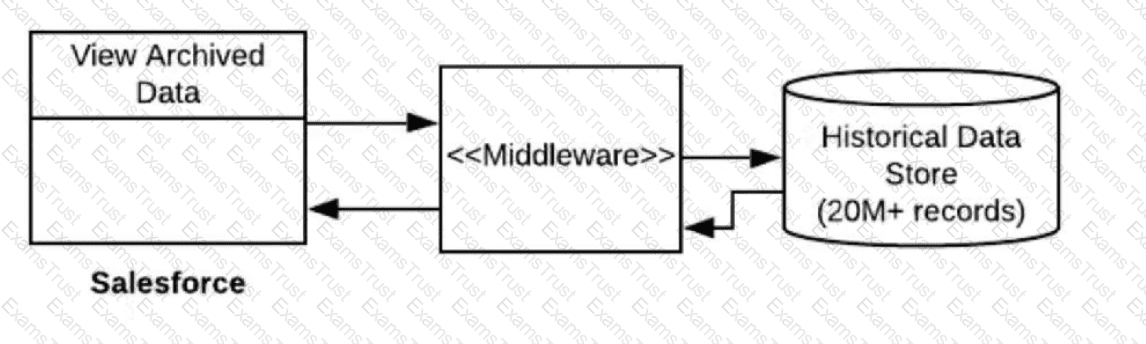
Which mechanism and patterns are recommended to maximize declarative configuration?
A large consumer goods manufacturer operating in multiple countries is planning to implement Salesforce for its sales and support operations globally. The Manufacturer has the following security requirements:
Internal users from each country have to be authenticated with their local active directory.
Customers can create their own login or use Google login.
Partners have to be authenticated through a central system which is to be determined.
Internal users will have access to the central Enterprise Resource Planning (ERP) with their credentials maintained in the ERP system.
Additional internal systems will be integrated with Salesforce for sales and support business processes.
Which requirement should the integration architect evaluate while designing the integration needs of this project?
Northern Trail Outfitters leverages Sales Cloud. When an opportunity has changed its status to “Closed/Won” and there are products attached, the details should be passed to the OMS for fulfillment operations. The callout from Salesforce to the OMS should be synchronous. What should an integration architect do to satisfy these requirements?
Northern Trail Outfitters is creating a distributable Salesforce package. The package needs to call into a custom Apex REST endpoint in the central org. The security team wants to ensure a specific integration account is used in the central org that they will authorize after installation of the package. Which item should an architect recommend to secure the integration?
A new Salesforce program requires data updates between internal systems and Salesforce. Which relevant details should a Salesforce integration architect seek to solve for the integration architecture needs of the program?
An integration architect has designed a mobile application for Salesforce users to get data while on the road using a custom user interface (UI). The application is secured with OAuth and is currently functioning well. There is a new requirement where the mobile application needs to obtain the GPS coordinates and store them on a custom geolocation field. The geolocation field is secured with field-level security, so users can view the value without changing it. What should be don4e to meet the requirement?
Universal Containers (UC) support agents would like to open bank accounts on the spot. During the process, agents execute credit checks through external agencies. At any given time, up to 30 concurrent reps will be using the service. Which error handling mechanisms should be built to display an error to the agent when the credit verification process has failed?
The URL for a business-critical external service providing exchange rates changed without notice. Which solutions should be implemented to minimize potential downtime for users in this situation?
A media company recently implemented an IAM system supporting SAML and OpenId. The IAM system must integrate with Salesforce to give new self-service customers instant access to Salesforce Community Cloud. Which requirement should Salesforce Community Cloud support for self-registration and SSO?
Universal Containers (UC) is decommissioning its legacy CRM system and migrating data to Salesforce. The data migration team asked for a recommendation to optimize the performance of the data load. Which approach should be used to meet the requirement?
Northern Trail Outfitters requires an integration to be set up between one of its Salesforce orgs and an External Data Source using Salesforce Connect. The External Data Source supports Open Data Protocol. Which configuration should an integration architect recommend be implemented in order to secure requests coming from Salesforce?
Universal Containers (UC) has a legacy homegrown application that stores customer data. Sales representatives edit contact records in Salesforce. UC requirements: 1. Salesforce updates should update the homegrown application. 2. Synchronization should be event-driven. 3. Integration should be asynchronous. Which option should an architect recommend?
Service agents at Northern Trail Outfitters use Salesforce to manage cases and B2C Commerce for ordering. Which integration solution should an architect recommend in order for the service agents to see order history from a business-to-consumer (B2C) Commerce system?
An integration developer is developing an HR synchronization app for a client. The app synchronizes Salesforce record data changes with an HR system that’s external to Salesforce. What should the integration architect recommend to ensure notifications are stored for up to 3 days if data replication fails?
When a user clicks “Check Preferences” as part of a Lightning flow, preferences from an externally hosted RESTful service are to be checked in real time. The service has OpenAPI 2.0 definitions. Which integration pattern and mechanism should be selected?
Northern Trail Outfitters submits orders to the manufacturing system web service. Recently, the system has experienced outages that keep service unavailable for several days. Which solution should an integration architect recommend to handle errors during these types of service outages?1718
An Integration architect has built a solution using REST API, updating Account, Contact, and other related information. The data volumes have increased, resulting in higher API calls consumed, and some days the limits are exceeded. A decision was made to decrease the number of API calls using bulk updates. The customer prefers to continue using REST API to avoid architecture changes. Which REST API composite resources should the integration architect use to allow up to 200 records in one API call?
Northern Trail Outfitters (NTO) wants to improve the quality of callouts from Salesforce to its REST APIs. For this purpose, NTO will require all API Clients/consumers to adhere to REST API Markup Language (RAML) specifications that include the field-level definition of every API request and response Payload. The RAML specs serve as interface contracts that Apex REST API Clients can rely on. Which design specification should the integration architect include in the integration architecture to ensure that Apex REST API Clients’ unit tests confirm Adherence to the RAML specs?
Northern Trail Outfitters needs to use Shield Platform Encryption to encrypt social security numbers in order to meet a business requirement. Which action should an integration architect take prior to the implementation of Shield Platform Encryption?
What should an integration architect consider when recommending Platform Events as an integration solution?
A customer’s enterprise architect has identified requirements around caching, queuing, error handling, alerts, retries, event handling, etc. The company has asked the integration architect to help fulfill such aspects with its Salesforce program. Which recommendation should the integration architect make?
A company that is a leading provider of courses and training delivers courses using third-party trainers. The trainer for the company has to be verified by 10 different training accreditation verification agencies before providing training for the company. Each training accreditation agency has its own response time, which means it could take days to confirm a trainer. The company decided to automate the trainer accreditation verification process by integrating it with the agency’s web service1s. What is the recommended approach to automa2te this process?3456
Northern Trail Outfitters needs to make synchronous callouts to “available-to-promise” services to query product availability and reserve inventory during the customer checkout process. What should an integration architect consider when building a scalable integration solution?
Universal Containers (UC) is planning to implement Salesforce as its CRM system. Currently, UC has a marketing system for leads, Microsoft Outlook for contacts and emails, and an ERP for billing and payments. The proposed CRM should provide a single customer view. What should an integration architect consider to support this strategy?
The goals for implementing Salesforce include a 360-degree view, leveraging CRM for marketing, sales, and service, and reusing enterprise quoting/order management. Which three systems from the current landscape can be retired?
Northern Trail Outfitters has recently implemented middleware for orchestration of services across platforms. The Enterprise Resource Planning (ERP) system being used requires transactions be captured near real-time at a REST endpoint initiated in Salesforce when creating an Order object. Additionally, the Salesforce team has limited development resources and requires a low-code solution. Which option should fulfill the use case requirements?
An enterprise architect has requested the Salesforce integration architect to review the following (see diagram and description) and provide recommendations after carefully considering all constraints of the enterprise systems and Salesforce Platform limits.
There are multiple eligibility systems that provide this service and are hosted externally.34
However, their current response times could take up to 90 seconds to process and return.
These eligibility systems can be acc8essed through APIs orchestrated via ESB (MuleSoft).
All requests from Salesforce must traverse the customer’s API Gateway layer, which imposes a constraint of timing out requests after 9 seconds.
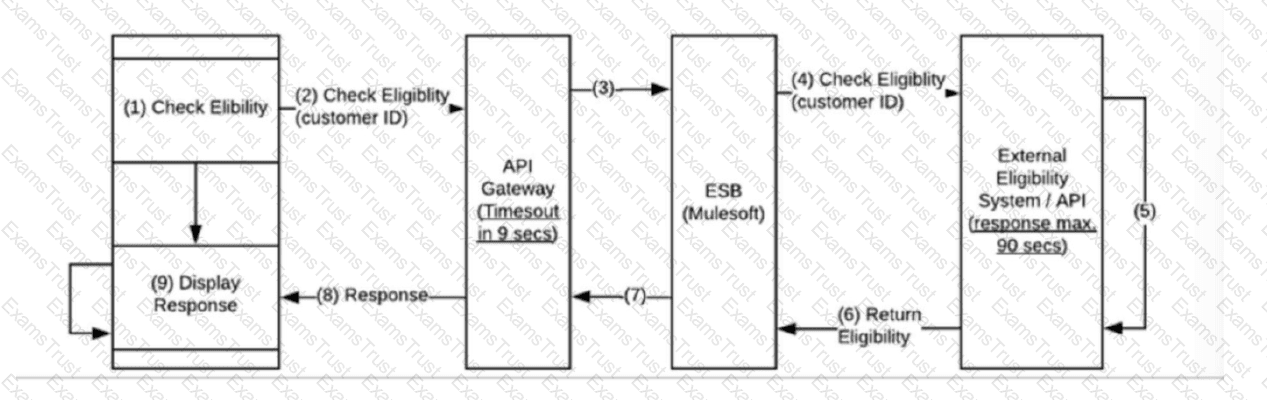
Which recommendation should the integration architect make?
Northern Trail Outfitters has had an increase in requests from other business units to integrate opportunity information with other systems from Salesforce. The developers have started writing asynchronous @future callouts directly into the target systems. The CIO is concerned about the viability of this approach and scaling for future growth. What should be done to mitigate the CIO’s concerns?
Northern Trail Outfitters is in the final stages of merging two Salesforce orgs, but needs to keep the retiring org available for a short period of time for lead management as it is connected to multiple public website forms. The sales department has requested that new leads are available in the new Salesforce instance within 30 minutes. Which approach requires the least amount of development effort?
A customer is evaluating the Platform Events solution and would like help in comparing/contrasting it with Outbound Messaging for real-time/near-real time needs. They expect 3,000 customers to view messages in Salesforce. What should be evaluated and highlighted when deciding between the solutions?12