
Weekend Sale Limited Time 70% Discount Offer - Ends in 0d 00h 00m 00s - Coupon code: 70special

Paloalto Networks XSOAR-Engineer Palo Alto Networks XSOAR Engineer Exam Practice Test

Palo Alto Networks XSOAR Engineer Questions and Answers

Testing Engine

  • Product Type: Testing Engine
$37.5  $124.99

PDF Study Guide

  • Product Type: PDF Study Guide
$33  $109.99
Question 1

While testing a custom integration, an XSOAR engineer noticed that the incident fetch interval is missing. How can this be fixed?

Options:

A.

Define the Incident Fetch Interval when running the integration’s commands.

B.

Duplicate the integration. Edit the resulting copy and add incidentFetchInterval as a parameter. Save the integration. Configure the new integration instance with the interval required.

C.

Configure the application to send incidents on the required interval.

D.

Duplicate the integration. Add the interval in the code. Save the integration and Configure the new integration instance with the interval required.

Question 2

A playbook task is set up to run an integration command that takes no input and which outputs information to the context. The integration has several instances configured.

Which action will ensure the integration command only runs once?.

Options:

A.

Specify the using- parameter to target a specific integration instance to run.

B.

Click on Advanced Options → Limits to specify the minimum / maximum run limits for a command.

C.

Click on Performance → Run Limits to specify the maximum run count before the task exits.

D.

Specify the runlimit= parameter to limit the number of times a specific command will run.

Question 3

Select the correct incident life cycle on XSOAR.

Options:

A.

Planning > Incident Ingestion > Incident Creation > Mapping and Classification > Pre-processing > Playbook runs > Post-processing

B.

Planning > Incident Ingestion > Pre-processing > Incident Creation > Mapping and Classification > Playbook runs > Post-processing

C.

Planning > Incident Ingestion > Pre-processing > Mapping and Classification > Incident Creation > Playbook runs > Post-processing

D.

Planning > Incident Ingestion > Mapping and Classification > Pre-processing > Incident Creation > Playbook runs > Post-processing

Question 4

Which task type would be used to verify/check that an integration was enabled?

Options:

A.

Standard task

B.

Conditional task

C.

Section Header task

D.

Data Collection task

Question 5

In which two locations can filters and transformers be used in XSOAR? (Choose two.)

Options:

A.

Classification and Mapping

B.

Playbook Tasks

C.

Evidence Fields

D.

Incident Fields

Question 6

Which two options will troubleshoot an integration’s fetch incidents command? (Choose two.)

Options:

A.

In the instance settings, enable the fetch incidents parameter and wait for one minute

B.

Create a one task playbook with a fetch-incident command

C.

execute !-fetch

D.

execute !-fetch

Question 7

In which two scenarios would it be appropriate to implement a loop for a sub-playbook? (Choose two.)

Options:

A.

In repetitive process flows to iterate for each playbook input

B.

When continuously ingesting incidents from third-party systems

C.

In repetitive process flows with no more than 10 loops

D.

In repetitive processes that requires sub-playbook re-execution

Question 8

A SOC manager built a dashboard and would like to share the dashboard with other team members. How would the SOC manager create a dashboard that meets this requirement?

Options:

A.

Manually share the dashboard through user emails

B.

Dashboard is shared to all XSOAR users

C.

Propagate the dashboard based on SAML authentication

D.

Dashboard is shared to all XSOAR users in a selected role

Question 9

Which two solutions are available to scale an overloaded XSOAR environment? (Choose two.)

Options:

A.

Add a distributed database server

B.

Add an indexing server

C.

Add a live backup server (disaster recovery)

D.

Add an engine

Question 10

In which three locations can an engineer try to find information, when troubleshooting a failed integration instance error produced by the test button? (Choose three.)

Options:

A.

The audit log

B.

The log bundle

C.

The source code for an integration

D.

The error message returned directly below the button

E.

The playground war room

Question 11

Where are incident layouts customized?

Options:

A.

Settings > Object Setup > Incidents > Layouts

B.

Settings > Integrations > Instance configuration

C.

Settings > Object Setup > Indicators > Layouts

D.

Settings > Advanced > Incident Layouts

Question 12

What are inputs and outputs in reference to a Playbook Development Lifecycle? (Choose three.)

Options:

A.

Inputs are data pieces that are present in the playbook

B.

Inputs are data pieces that are present in the task

C.

Outputs are used as incident trigger for playbook

D.

Outputs can be derived from the result of a task or command

E.

Inputs are the data fields parsed by the Classifier

Question 13

What can you use to assign a layout, field, and playbook to an incoming incident?

Options:

A.

Playbook

B.

Classification and mapping

C.

Incident type

D.

Pre-processing

Question 14

What does Script helper contain?

Options:

A.

Available commands

B.

Permission settings

C.

Automation version history

D.

Automation timeout configuration

Question 15

Arrange these steps in the order that they occur during an incident fetch.
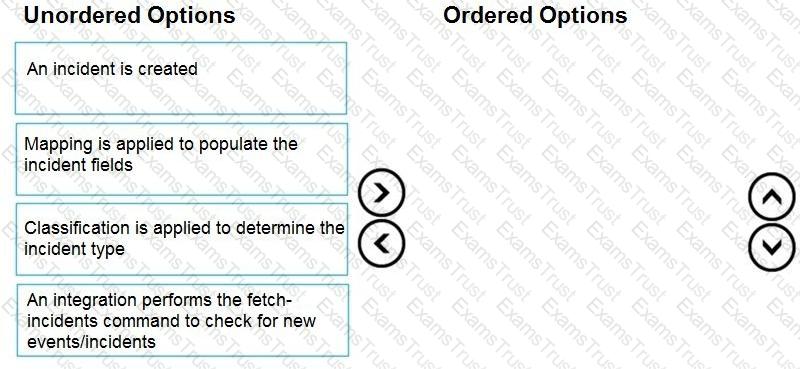
Options:

Question 16

Where does the mapping of user groups to SAML groups take place?.
Options:

A.

Cortex Gateway.

B.

Tenant.

C.

Customer Support Portal.

D.

Palo Alto Networks Hub.

Question 17

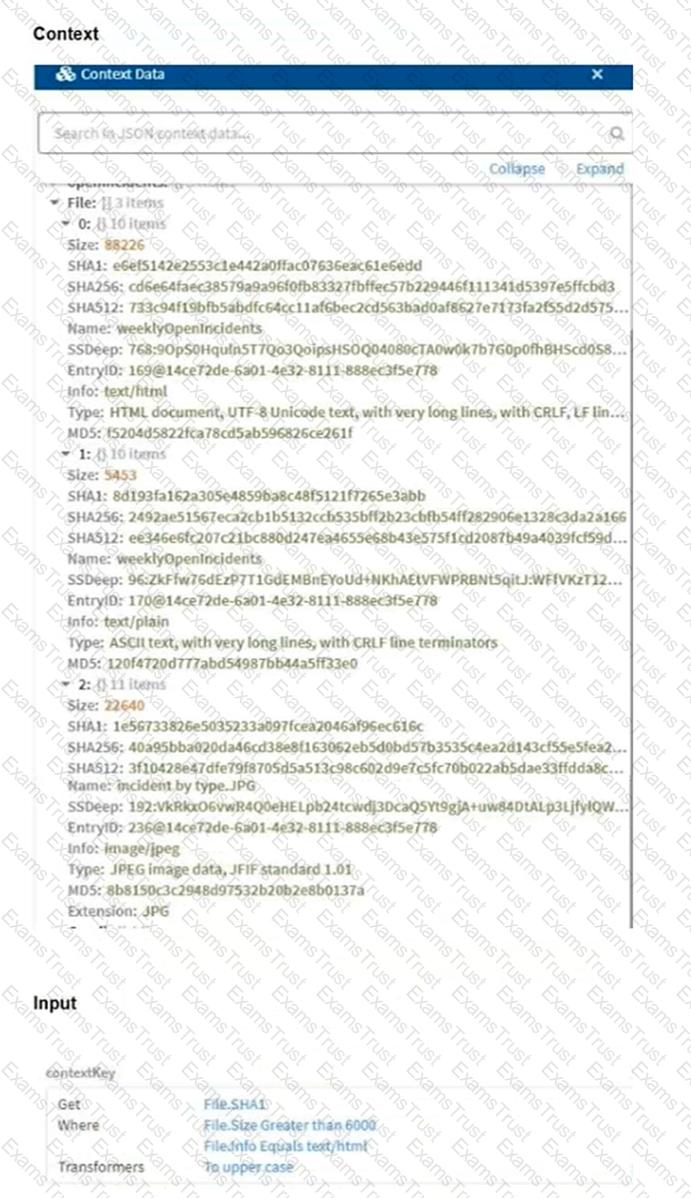
Given the following context data, what would be the expected output of the expression?

Options:

A.

1E56733826E5035233A097FCEA2046AF96EC616C

B.

E6EF5142E2553C1E442A0FFAC07636EAC61E6EDD

C.

8D193FA162A305E4859BA8C45F5121F7265E3ABB

D.

e6ef5142e2553c1e442a0ffac07636eac61e6edd

Question 18

An engineer defined a dashboard which allows important metrics to be displayed. The engineer would like to make this dashboard the default dashboard.

How can it be accomplished?

Options:

A.

Default Dashboard can be defined by ‘Role’

B.

Use the server configuration key: default.dashboards

C.

Save the dashboard as a widget and apply it to all users

D.

Right click on the dashboard tab and ‘Set as Default’

Question 19

Previous playbook tasks have built out the context in the image below.
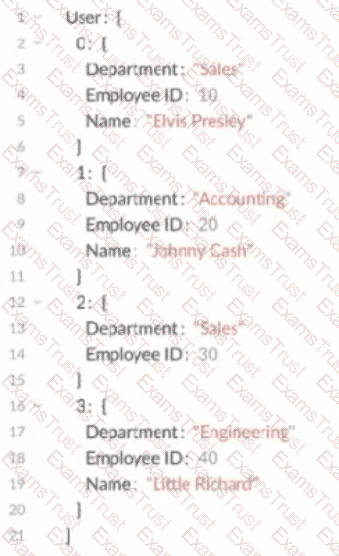
When specifying ${User.Name} as an input for a sub playbook task which has the default loop configuration, how many times will the sub-playbook be executed?.

Options:

A.

0.

B.

1.

C.

3.

D.

4.

Question 20

An engineer asked for a specific command in an integration but the capability does not exist. The engineer decided to edit the existing integration by copying the integration and adding the needed commands.

What is the main concern when adding these commands?

Options:

A.

The commands must return a proper result to the war room for the analysts to understand

B.

The code may not be written to XSOAR standards

C.

The integrations are locked and cannot be edited with additional commands

D.

The custom integration will not be maintained and updated by XSOAR content team

Question 21

An engineer adds a new "Forensics" tab that includes several sections for detailed artifact analysis to the "Malware Incident" layout. However, junior analysts report they cannot see this tab, while senior analysts can.

Which configuration setting is the most likely reason for this discrepancy?.

Options:

A.

The underlying fields within the tab sections was incorrectly mapped.

B.

The tab was not added to the junior analyst role group.

C.

The tab was marked as read-only in the layout configuration for the junior analyst roles.

D.

A display filter was applied to the tab in the layout editor.

Question 22

Which playbook will a job run by default?

Options:

A.

The playbook assigned to the incident type

B.

The playbook assigned to the indicator type

C.

The playbook assigned during pre-processing

D.

The playbook assigned by the integration

Question 23

When creating a new tab in the layout, which section cannot be added?

Options:

A.

Retrieve widget chart based on script

B.

Related incidents

C.

War room entries picked by entry query

D.

Incident team members

Question 24

What is the result of an indicator being marked as expired?.

Options:

A.

It still exists and can be searched.

B.

It is immediately deleted from the database.

C.

It still exists but is not searchable.

D.

It is deleted from the database after seven days.

Question 25

Which of the following is a feature of XSOAR automations?

Options:

A.

can run on multiple docker containers

B.

can be set to run on a scheduled basis in the automation settings

C.

can be password protected

D.

can be written in C++

Question 26

Which two statements accurately describe layouts? (Choose two.)

Options:

A.

Layouts override classification and mapping

B.

New tabs can be added to the incident layout

C.

Layouts can display incident information and custom fields

D.

Layouts add or remove custom fields from an incident type

Question 27

Which development languages are supported when creating XSOAR automation scripts?

Options:

A.

C++, Python, Powershell

B.

Ruby, C++, Python

C.

Javascript, Powershell, C++

D.

Python, Powershell, Javascript

Question 28

Which two incident search queries are valid? (Choose two.)

Options:

A.

created:>=”7 days”

B.

owner===admin

C.

role is Analyst

D.

status:closed –category:job

Question 29

When re-assigning an existing incident to a new incident type, an engineer is concerned about the preservation of critical data currently stored in fields that are only associated to the original incident type.

Upon making the change, in which state will the critical data be in the now unassociated fields?.

Options:

A.

Hidden from the Context Data but accessible.

B.

Visible within Context Data and fully accessible.

C.

Visible with Context Data, grayed out, and fully accessible.

D.

Hidden from Context Data and no longer accessible.

Question 30

Which two capabilities do Automation script settings include? (Choose two.)

Options:

A.

Define ‘parameters’

B.

Correlate to incident types

C.

Define ‘outputs’

D.

Set password protection

Question 31

Which two situations would an engineer consider when configuring classification and mapping for an incident type? (Choose two.)

Options:

A.

When creating incidents from the XSOAR REST API

B.

When manually creating an incident from the UI

C.

When adding a new analyst account to XSOAR

D.

When fetching many different incident types from a single mailbox

Question 32

When creating an incident layout section, it is best to place long field values within which of the following?

Options:

A.

Section headers

B.

Rows

C.

Canvas

D.

Cards

Question 33

What is the default task type when creating an empty task?

Options:

A.

Standard (Manual)

B.

Conditional

C.

Section header

D.

Standard (Automated)

Question 34

Which three scripting languages can an engineer use to write XSOAR automations? (Choose three.)

Options:

A.

Python

B.

Perl

C.

Go

D.

JavaScript

E.

Powershell

Question 35

What can be added to offload integration instance processing from the main server?

Options:

A.

Database node

B.

Application server

C.

Engine

D.

Development server

Question 36

In which two options can an automation script be executed? (Choose two.)

Options:

A.

Engine

B.

Integration

C.

War room

D.

Playbook

Question 37

Which two features does XSOAR offer to help recover from a server failure? (Choose two.)

Options:

A.

Live backup (disaster recovery)

B.

Distributed database

C.

Backup data to XSOAR engines

D.

Local backup

Question 38

After executing the DeleteContext automation with all=yes argument, how would the context data of an incident present?

Options:

A.

All the data, including the incident key will be deleted, and the context data will be completely empty.

B.

No difference, the automation cannot be executed manually.

C.

All context data, including custom incident fields will be deleted, system incident fields will remain.

D.

All context data, except the incident key will be deleted.

Question 39

Where is a custom layout for an incident configured?.

Options:

A.

Pre-process rule.

B.

Incident playbook.

C.

Integration instance settings.

D.

Incident type.

Question 40

Which two options are the most effective for moving content between two environments? (Choose two.)

Options:

A.

Remote repository based content sharing

B.

UI based content import/export button

C.

Copy the content backup from one environment file system (/var/lib/demisto/backup/content- backup-*) and move it to the other environment

D.

Download the content items separately and upload them to the other environment

Question 41

Which two components have their own context data? (Choose two.)

Options:

A.

Sub-playbook

B.

Task

C.

Field

D.

Incident

Question 42

What aggregates data from incidents and indicators into a Cortex XSOAR report?.

Options:

A.

Widgets.

B.

Automations.

C.

SQL queries.

D.

Playbooks.

Question 43

If a known malicious domain is no longer associated with a specific IP address, which action will make the association inactive?.

Options:

A.

Revoke the relationship.

B.

Update the relationship type.

C.

Expire the IP address indicator.

D.

Update the indicator relationship description.

Question 44

Which two actions will group similar incidents that share a common root cause or represent different aspects of a larger problem? (Choose two.).

Options:

A.

Relate Incidents.

B.

Add Child Incidents.

C.

Join Incidents.

D.

Merge Incidents.

Question 45

What are the out-of-the-box aggregate values that can be applied on widgets data?

Options:

A.

Min, Max, Count, Average, Custom Transformers

B.

Min, Max, Count, Average, Custom Group By

C.

Count, Average, Sum, Min, Max

D.

Count, Sum, Min, Max, Transformers

Question 46

Within the playbook editor, which function allows a user to associate a task output to an incident field?.

Options:

A.

Classification.

B.

Inputs.

C.

Extend context.

D.

Mapping.

Question 47

Reliability scores in XSOAR range from A through F. What do A and F stand for?

Options:

A.

F - Reliability cannot be judged, A - Completely Reliable

B.

F - Not reliable, A - Usually Reliable

C.

F - Not usually reliable, A - Fairly Reliable

D.

F - Unreliable, A - Completely Reliable

Question 48

Which of the following does a XSOAR Admin need to create an integration with a third party cloud application?

Options:

A.

Marketplace access

B.

Application with API

C.

Private key/Public key integration

D.

Multitenant deployment

Question 49

Which two statements describe how timers are configured to start and stop automatically in a playbook? (Choose two.)

Options:

A.

Use a field of Number to count the number of seconds elapsed between two tasks

B.

After the playbook has run, calculate the total time taken and set the timer field with this value

C.

To begin counting time taken, add a task in the playbook with automation startTimer. To end the counting, add a task with automation stopTimer

D.

From the Timers tab of the playbook task, choose the action for the timer and the timer field to perform the action on

Question 50

Which two input requirements are needed to train a machine learning model? (Choose two.)

Options:

A.

3000 Incidents

B.

Incident Field

C.

Verdict Label

D.

Incident Type

Question 51

Assuming an incident type configuration runs the associated playbook automatically, which pre-process rule action can preserve matching incidents without triggering the playbook?.

Options:

A.

Close.

B.

Update.

C.

Drop.

D.

Link.

Question 52

For troubleshooting, after a log bundle is created, where do the logs appear on the XCSOAR server?

Options:

A.

/var/lib/demisto

B.

/tmp/log/demisto

C.

/usr/local/demisto

D.

/var/log/demisto

Question 53

A Cortex XSOAR Administrator is tasked with building a button for an analyst in order for the analyst to be assigned to the incident as an owner. What is the process?

Options:

A.

Edit the incident layout to add a new button that calls the AssignAnalystToIncident automation with no argument

B.

Edit the incident layout to add a new button that calls the AssignToMeButton automation with argument assignBy={me}

C.

Edit the incident layout to add a new button that calls the AssignAnalystToIncident automation with argument owner={me}

D.

Edit the incident layout to add a new button that calls the AssignAnalystToIncident automation with argument assignBy=current

Question 54

The XSOAR administrator is writing an automation and would like to return an error entry back into XSOAR if a particular command errors out. How can this be achieved?

Options:

A.

Using the demisto_error() function

B.

Using a print statement

C.

Using the demisto.debug() function

D.

Using the return_error() function

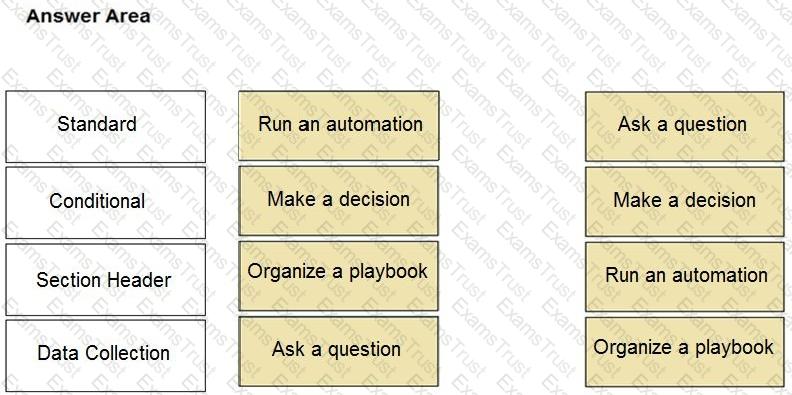
Question 55

Match the action with the most appropriate playbook task type.
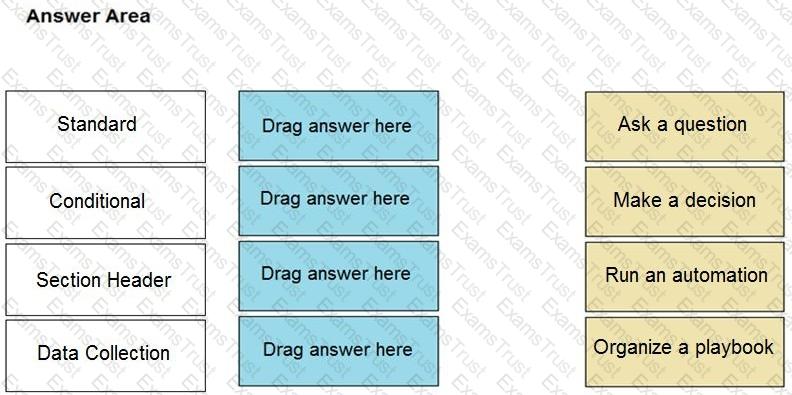
Options:

Question 56

An engineer is developing a playbook that will be run multiple times for testing purposes. What is the recommended first task to be used in the playbook?

Options:

A.

DeleteContext

B.

GenerateTest

C.

PrintContext

D.

SetContext

Question 57

Which three support types are included in the Marketplace Content Packs? (Choose three.)

Options:

A.

Customer supported

B.

Contex XSOAR supported

C.

Community supported

D.

Partner supported

E.

Prisma Cloud supported

Question 58

On the System Diagnostics page, what is the default minimum size for a Work Plan to be considered big?

Options:

A.

2MB

B.

3MB

C.

1MB

D.

5MB

Question 59

What assigns newly ingested event attributes to incident fields?

Options:

A.

Playbooks

B.

Classification

C.

Mapping

D.

Layouts

Question 60

Which component can be part of a load balancing group?

Options:

A.

Distributed database

B.

D2 agent

C.

Engine

D.

Load balancing server

Question 61

Given an incident with three files, how could the name of the second file be referenced?

Options:

A.

${Files.[2].Name}

B.

${Files.Name.[2]}

C.

${File.[1].Name}

D.

${File.Name.[1]}