

Big Cyber Monday Sale Limited Time 70% Discount Offer - Ends in 0d 00h 00m 00s - Coupon code: 70special

OMG OMG-OCEB2-FUND100 OMG-Certified Expert in BPM 2 - Fundamental Exam Practice Test

OMG-Certified Expert in BPM 2 - Fundamental Questions and Answers

Testing Engine

  • Product Type: Testing Engine
$37.5  $124.99

PDF Study Guide

  • Product Type: PDF Study Guide
$33  $109.99
Question 1

Choose the correct answer:

Given the following BPMN model:
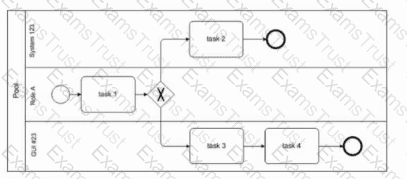
Is the concept of lanes applied correctly in this model?

Options:

A.

No, lanes are only allowed outside pools.

B.

No, lanes must always be used to indicate organizational units.

C.

No, lanes must always be used to indicate systems but not GUIs.

D.

Yes, lanes can be used as shown in the model.

Question 2

Choose the correct answer:

Which statement is true about Boundary Events?

Options:

A.

Only Error, Cancel, and Compensation Boundary Events are exclusively Interrupting Boundary Events.

B.

A Non-Interrupting Error Boundary Event leads to an exception Sequence Flow only when its Task completes.

C.

An Interrupting Boundary Event is distinguished from its Non-Interrupting Boundary Event form by its dashed, double ring.

D.

If a Boundary Event has two or more exiting Sequence Flows, those Sequence Flows must be labeled with their respective conditions and only one sequence flow can be taken.

Question 3

Choose the correct answer:

Which description of text annotation in BPMN is true?

Options:

A.

The text annotation object affects the flow of the process.

B.

A text annotation object can be connected exclusively to pools, lanes, or groups.

C.

The text annotation object is connected to an object with an association.

D.

Text annotation can be represented as this graphic object.

Question 4

Choose the correct answer:

Which statement describes a legitimate way to commence a parallel flow?

Options:

A.

Multiple paths exit an exclusive gateway.

B.

Multiple conditional paths exit an activity.

C.

Multiple unconditional paths exit an activity.

D.

Multiple default paths exit an exclusive gateway.

Question 5

Choose the correct answer:

Why is Service Oriented Architecture (SOA) beneficial to BPM?

Options:

A.

SOA allows monolithic applications to be replaced by new innovative systems.

B.

SOA removes the reliance of processes on the technologies of underlying applications.

C.

SOA permits IT to create customized solutions to satisfy each department's specific needs.

D.

SOA forces a comprehensive integration between processes and their essential back-end systems.

Question 6

Choose the correct answer:

What is a public business process?

Options:

A.

It is a process that provides features that its sub-processes can inherit.

B.

It is a process that represents the interactions between a private business process and another process.

C.

It is a process that only interacts with people or organizations outside the organization of the business process.

D.

It is a process that creates output for people or organizations outside the organization of the business process.

Question 7

Choose the correct answer:

Which elements of the Business Motivation Model (BMM) govern Courses of Action?

Options:

A.

Directives

B.

Objectives

C.

Internal Influencers

D.

Business Processes

Question 8

Choose the correct answer:

The chief economist of an airline projects increasing costs for jet fuel and believes those costs will hurt the airline's business.

This belief is modeled as which BMM noun concept?

Options:

A.

A risk

B.

A goal

C.

An influencer

D.

An assessment

Question 9

Choose the correct answer:

A winery notices that its younger consumers—those younger than 30—are buying more Chilean wine. You model this trend as the Business Motivation Model (BMM) element Younger customers buying more Chilean wine.

What is this model element?

Options:

A.

A Threat

B.

An Influencer

C.

An Assessment

D.

A Course of Action

Question 10

Choose the correct answer:

According to Martyn Ould, how should an analyst reconcile what people actually do and what they effectively do?

Options:

A.

An analyst should make sure that what people actually do (a concrete model) is reflected in an abstract model.

B.

An analyst should create a one-to-one mapping between the two concepts. All inconsistencies should be removed before implementation of the model.

C.

An analyst should model those two concepts in two layers – M1 and M2. Then the analyst will need to check the model for inconsistencies.

D.

An analyst should not try to reconcile them. These are two different views of the same thing.

Question 11

Choose the correct answer:

In which order are activities C and D in this diagram executed?
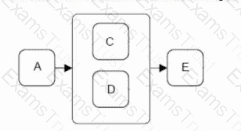
Options:

A.

C is executed first and D second.

B.

D is executed first and C second.

C.

C and D are executed in parallel.

D.

C and D are executed in an undefined order.

Question 12

Choose the correct answer:

Which statement describes the concept of an End Event in BPMN?

Options:

A.

An End Event is a pointer to the last activity.

B.

An End Event marks the end of a path through a Process.

C.

An End Event is the last event that is generated by the Process.

D.

An End Event is the connection point between the Sub-Process and its parent Process.

Question 13

Choose the correct answer:

What is the meaning of an Expanded Sub-Process that lacks Sequence Flows between its Tasks?

Options:

A.

The Tasks are performed in Top to Bottom and Left to Right order, each Task executed once.

B.

The diagram is flawed: Tasks within a Sub-Process must be connected with Sequence Flows.

C.

The Tasks are performed in any order for any number of times including the possibility of skipping one or more of the Tasks entirely. These Tasks are performed until the Process arbitrarily decides to cease the execution.

D.

Each Task is performed once and only once, the order of execution is not specified, all the Tasks are simultaneously enabled for execution, and the execution of each Task can be contemporaneous with the others.

Question 14

Choose the correct answer:

According to Chang in Business Process Management Systems, which is the key enabler of Business Process Re-engineering (BPR)?

Options:

A.

Incremental change

B.

Labor specialization

C.

Information technology

D.

Strong functional structure

Question 15

Choose the correct answer:

When connecting Flow Objects with Message Flows, which constraint is valid?

Options:

A.

Message Flows must be at a 90 degree angle from Sequence Flows.

B.

A Message Flow cannot connect a Pool with a Collapsed Sub-Process.

C.

Message Flows cannot connect to Flow Objects that are within the same Pool.

D.

A Message Flow cannot connect a Message End Event with a Catch-Message Intermediate Event.

Question 16

Choose the correct answer:

In Six Sigma analysis, the distinction between "common cause of variation" and "special cause of variation" is a key distinction.

In this diagram, which data points are characterized by common cause of variation?
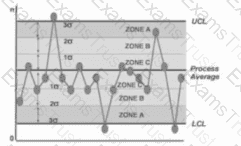
Options:

A.

the data points within 1 sigma of the process average (within zone C)

B.

the data points inside the upper and lower control limits (UCL and LCL)

C.

the data points outside the upper and lower control limits (UCL and LCL)

D.

the data points within 2 sigma of the process average (within zones B and C)

E.

data points in the zone on the graph that contains the largest number of data points

Question 17

Choose the correct answer:

What is wrong with this BPMN diagram?
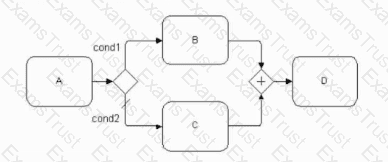
Options:

A.

The gateways are interchanged.

B.

The activity D can never be reached.

C.

It is not deterministic if B or C follows A.

D.

The condition expressions of the exclusive gateway are not marked correctly.

Question 18

Choose the correct answer:

In filmmaking, a production day begins with producing scenes. When production is complete, the sound mixer reviews the sound and, simultaneously, the director reviews the pictures. Finally, the director plans the next shooting day based on all of the review results.

Which BPMN diagram depicts this process?
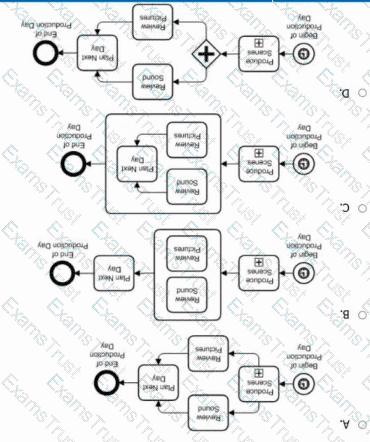
Options:

A.

Option A

B.

Option B

C.

Option C

D.

Option D

Question 19

Choose the correct answer:

In a process-focused or process-centric organization, a formal governing body that oversees enterprise processes should also do what?

Options:

A.

Firefight business problems

B.

Define the organization's business strategy

C.

Prioritize initiatives and allocate resources

D.

Define the organization's senior executive structure

Question 20

Choose the correct answer:

Which factor directly affects the complexity of a process?

Options:

A.

The number of steps

B.

The number of branches

C.

The number of instances

D.

The number of people using it

Question 21

Choose the correct answer:

All Start Events for an Embedded Sub-Process must be of which type?

Options:

A.

Signal

B.

Multiple

C.

Message

D.

None

Question 22

Choose the correct answer:

Given this process:
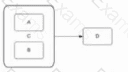
which alternative representation will execute identically?
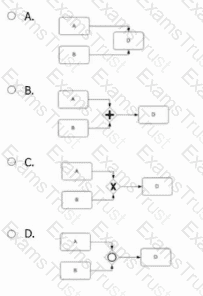
Options:

A.

Option A

B.

Option B

C.

Option C

D.

Option D

Question 23

Choose the correct answer:

Which statement correctly states the order of sending and receiving Messages between the Producer and the Consumer?

Options:

A.

Consumer sends Message 1 to Producer; Producer sends Message B to Consumer; Consumer sends Message A to Producer.

B.

Consumer sends Message 1 and Message A simultaneously and Producer sends Message B before, during, or after Message 1 and Message A arrive.

C.

The order of sending and receiving Messages cannot be determined from the diagram.

D.

No Messages are exchanged because the diagram illustrates invalid BPMN; a Collaboration between two Participants must involve only a pair of exchanged Messages.

Question 24

Choose the correct answer:

What is the meaning of a collaboration containing two white box pools?

Options:

A.

The diagram shows one process.

B.

There are two participants involved in one process.

C.

Each pool indicates a participant.

D.

The process diagram must at least show two lanes.

Question 25

Choose the correct answer:

As an enterprise becomes process-oriented, how do its values shift?

Options:

A.

From horizontal to vertical process structures

B.

From process improvement to structured policies

C.

From individual recognition to process excellence

D.

From root cause analysis to individual department performance

Question 26

Choose the correct answer:

What are the two major groups (enterprise-level categories) in the APQC Process Classification Framework?

Options:

A.

Operations Processes and Governance Processes

B.

Operating Processes and Management and Support Processes

C.

Information Technology Processes and Business Operations Processes

D.

Process Management Processes and Development and Delivery Processes

Question 27

Choose the correct answer:

Select the list of BPMN Activities:

Options:

A.

Task, Process

B.

Task, Sub-Process

C.

Task, Process, Action

D.

Task, Sub-Process, Action

E.

Task, Process, Sub-Process