
Big Cyber Monday Sale Limited Time 70% Discount Offer - Ends in 0d 00h 00m 00s - Coupon code: 70special

Netskope NSK300 Netskope Certified Cloud Security Architect Exam Exam Practice Test

Page: 1 / 7
Total 68 questions

Netskope Certified Cloud Security Architect Exam Questions and Answers

Testing Engine

  • Product Type: Testing Engine
$37.5  $124.99

PDF Study Guide

  • Product Type: PDF Study Guide
$33  $109.99
Question 1

You are implementing Netskope Cloud Exchange in your company lo include functionality provided by third-party partners. What would be a reason for using Netskope Cloud Risk Exchange in this scenario?

Options:

A.

to ingest events and alerts from a Netskope tenant

B.

to feed SOC with detection and response services

C.

to map multiple scores to a normalized range

D.

to automate service tickets from alerts of interest

Question 2

Your customer is currently using Directory Importer with Active Directory (AD) to provision users to Nelskope. They have recently acquired three new companies (A. B. and C) and want to onboard users from the companies onto the NetsKope platform. Information about the companies is shown below.

- Company A uses Active Directory.

-- Company B uses Azure AD.

-- Company C uses Okta Universal Directory.

Which statement is correct in this scenario?

Options:

A.

Users from Company B and Company C cannot be provisioned because the customer is already using AD Importer.

B.

Either Company B or Company C users cannot be provisioned because integration with only one SCIM solution is allowed.

C.

Users from Companies A. B, and C can be provisioned to Netskope by deploying additional AD Importers and integrating more than one SCIM solution.

D.

Company A users cannot be provisioned to Netskope because the customer is already using AD Importer to import users from another Active Directory environment.

Question 3

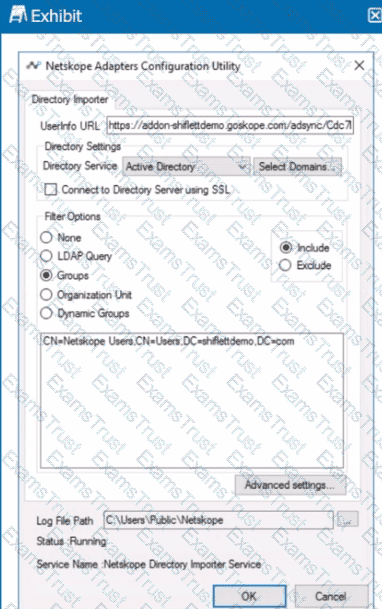
Review the exhibit.

You installed Directory Importer and configured it to import specific groups ot users into your Netskope tenant as shown in the exhibit. One hour after a new user has been added to the domain, the user still has not been provisioned to Netskope.

What are three potential reasons for this failure? (Choose three.)

Options:

A.

Directory Importer does not support ongoing user syncs; you must manually provision the user.

B.

The server that the Directory Importer is installed on is unable to reach Netskope's add-on endpoint.

C.

The user is not a member of the group specified as a filter

D.

Active Directory integration is not enabled on your tenant.

E.

The default collection interval is 180 minutes, therefore a sync may not have run yet.

Question 4

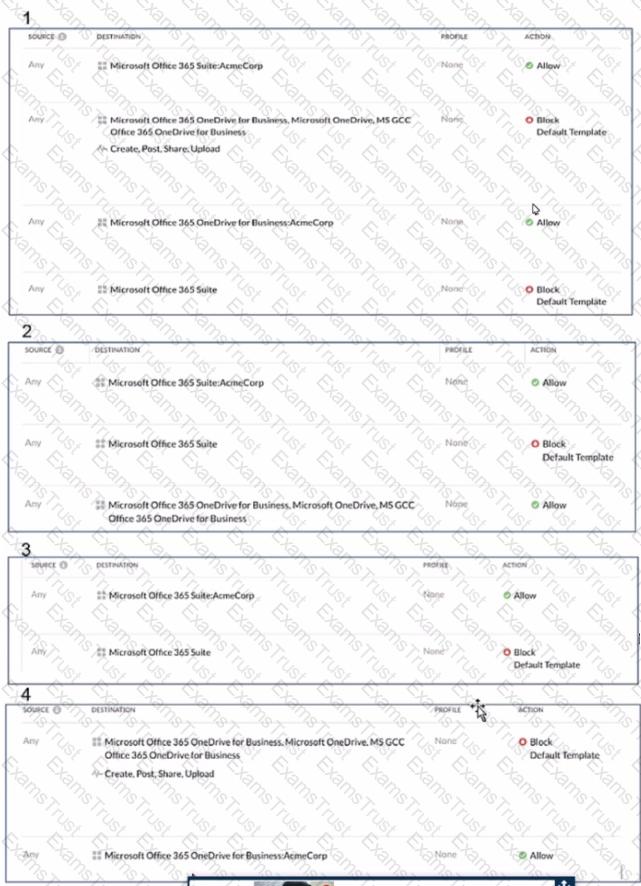
Review the exhibit.

AcmeCorp has recently begun using Microsoft 365. The organization is concerned that employees will start using third-party non-AcmeCorp OneDrive instances to store company data. The CISO asks you to use Netskope to create a policy that ensures that no data is being uploaded to non-AcmeCorp instances of OneDrive.

Referring to the exhibit, which two policies would accomplish this posture? (Choose two.)

Options:

A.

4

B.

3

C.

2

D.

1

Question 5

Your Netskope Client tunnel has connected to Netskope; however, the user is not receiving any steering or client configuration updates What would cause this issue?

Options:

A.

The client is unable to establish communication to add-on-[tenantl.goskope.com.

B.

The client is unable to establish communication to gateway-(tenant|.goskope.com.

C.

The Netskope Client service is not running.

D.

An invalid steering exception was created in the tenant

Question 6

You successfully configured Advanced Analytics to identify policy violation trends Upon further investigation, you notice that the activity is NULL. Why is this happening in this scenario?

Options:

A.

The SSPM policy was not configured during setup.

B.

The REST API v1 token has expired.

C.

A policy violation was identified using API Protection.

D.

A user accessed a static Web page.

Question 7

Review the exhibit.

A user has attempted to upload a file to Microsoft OneDrive that contains source code with Pll and PCI data.

Referring to the exhibit, which statement Is correct?

Options:

A.

The user will be blocked and a single Incident will be generated referencing the DLP-PCI profile.

B.

The user will be blocked and a single Incident will be generated referencing all of the matching DLP profiles

C.

The user will be blocked and a separate incident will be generated for each of the matching DLP profiles.

D.

The user will be alerted and a single incident will be generated referencing the DLP-PII profile.

Question 8

You do not want a scheduled Advanced Analytics dashboard to be automatically updated when Netskope makes improvements to that dashboard. In this scenario, what would you do to retain the original dashboard?

Options:

A.

Create a new dashboard from scratch that mimics the Netskope dashboard you want to use.

B.

Copy the dashboard into your Group or Personal folders and schedule from these folders.

C.

Ask Netskope Support to provide the dashboard and import into your Personal folder.

D.

Download the dashboard you want and Import from File into your Group or Personal folder.

Question 9

Review the exhibit.

You are attempting to block uploads of password-protected files. You have created the file profile shown in the exhibit.

Where should you add this profile to use in a Real-time Protection policy?

Options:

A.

Add the profile to a DLP profile that is used in a Real-time Protection policy.

B.

Add the profile to a Malware Detection profile that is used in a Real-time Protection policy.

C.

Add the profile directly to a Real-time Protection policy as a Constraint.

D.

Add the profile to a Constraint profile that is used in a Real-time Protection policy.

Question 10

You want to verify that Google Drive is being tunneled to Netskope by looking in the nsdebuglog file. You are using Chrome and the Netskope Client to steer traffic. In this scenario, what would you expect to see in the log file?

A)

B)

C)

D)

Options:

A.

Option A

B.

Option B

C.

Option C

D.

Option D

Question 11

Your CISO asks that you to provide a report with a visual representation of the top 10 applications (by number of objects) and their risk score. As the administrator, you decide to use a Sankey visualization in Advanced Analytics to represent the data in an efficient manner.

In this scenario, which two field types are required to produce a Sankey Tile in your report? {Choose two.)

Options:

A.

Dimension

B.

Measure

C.

Pivot Ranks

D.

Period of Type

Question 12

Your client is an NG-SWG customer. They are going to use the Explicit Proxy over Tunnel (EPoT) steering method. They have a specific list of domains that they do not want to steer to the Netskope Cloud.

What would accomplish this task''

Options:

A.

Define exception domains in the PAC file.

B.

Define exceptions in the Netskope steering configuration

C.

Create a real-time policy with a bypass action.

D.

Use an SSL decryption policy.

Question 13

You have deployed Netskope to all users of the organization and you are now ready to begin ingesting all events, alerts, and Web transactions into your SIEM as a part of your requirements.

What are three ways in which you would accomplish this task? (Choose three.)

Options:

A.

Use custom API calls to ingest to a data lake and then into your SIEM.

B.

Use the Netskope Publisher to a stream syslog to your SIEM.

C.

Use syslog directly to Splunk.

D.

Use Cloud Log Shipper to an IaaS storage repository and then into your SIEM.

Question 14

You are using Netskope CSPM for security and compliance audits across your multi-cloud environments. To decrease the load on the security operations team, you are researching how to auto-re mediate some of the security violations found in low-risk environments.

Which statement is correct in this scenario?

Options:

A.

Netskope does not support automatic remediation of security violation results due to the high risk associated with it.

B.

You can use Netskope API-enabled Protection for auto-remediation of security violation results.

C.

You can use Netskope Auto-remediation frameworks from the public Netskope GitHub Open Source repository for auto-re mediation of security violation results.

D.

You can use Netskope Cloud Exchange for auto-remediation of security violation results.

Question 15

You are deploying the Netskope Client to Windows devices. The following command line would be used to install the client MSI file:

In this scenario, what is referring to in the command line?

Options:

A.

a Netskope user identifier

B.

the Netskope organization ID

C.

the URL of the IdP used to authenticate the users

D.

a private token given to you by the SCCM administrator

Question 16

You want to see all instances of malware that were detected by the Netskope Cloud Sandbox.

Which process would you use to achieve this task in the Netskope tenant UI?

Options:

A.

Go to Incidents > Malicious Sites, and perform the detection_engine eq ‘Advanced Detection’ query.

B.

Go to Incidents > Malware and perform the detection_engine eq ‘Netskope Cloud Sandbox’ query.

C.

Go to Skope IT > Alerts, switch to Query Mode and perform the detection_engine eq ‘Netskope Cloud Sandbox’ query.

D.

Go to Skope IT > Page Events, switch to Query Mode and perform the detection_engine eq ‘Netskope Cloud Sandbox’ query.

Question 17

You configured a pair of IPsec funnels from the enterprise edge firewall to a Netskope data plane. These tunnels have been implemented to steer traffic for a set of defined HTTPS SaaS applications accessed from end-user devices that do not support the Netskope Client installation. You discover that all applications steered through this tunnel are non-functional.

According to Netskope. how would you solve this problem?

Options:

A.

Restart the tunnel to stop the tunnel from flapping.

B.

Downgrade from IKE v2 to IKE v1.

C.

Install the Netskope root and intermediate certificates on the end-user devices.

D.

Disable Perfect Forward Secrecy on the tunnel configuration.

Question 18

You need to extract events and alerts from the Netskope Security Cloud platform and push it to a SIEM solution. What are two supported methods to accomplish this task? (Choose two.)

Options:

A.

Use Cloud Ticket Orchestrator.

B.

Use Cloud Log Shipper.

C.

Stream directly to syslog.

D.

Use the REST API.

Question 19

You are the network architect for a company using Netskope Private Access. Multiple users are reporting that they are unable to access an application using Netskope Private Access that was working previously. You have verified that the Real-time Protection policy allows access to the application, private applications are steered for the users, and the application is reachable from internal machines. You must verify that the application is reachable through Netskope Publisher

In this scenario, which two tools in the Netskope Ul would you use to accomplish this task? (Choose two.)

Options:

A.

Reachability Via Publisher in the App Definitions page

B.

Troubleshooter tool in the App Definitions page

C.

Applications in Skope IT

D.

Clear Private App Auth under Users in Skope IT

Question 20

You have multiple networking clients running on an endpoint and client connectivity is a concern. You are configuring co-existence with a VPN solution in this scenario, what is recommended to prevent potential routing issues?

Options:

A.

Configure the VPN to split tunnel traffic by adding the Netskope IP and Google DNS ranges and set to Exclude in the VPN configuration.

B.

Modify the VPN to operate in full tunnel mode at Layer 3. so that the Netskope agent will always see the traffic first.

C.

Configure the VPN to full tunnel traffic and add an SSL Do Not Decrypt policy to the VPN configuration for all Netskope traffic.

D.

Configure a Network Location with the VPN IP ranges and add it as a Steering Configuration exception.

Page: 1 / 7
Total 68 questions