
Spring Sale Limited Time 70% Discount Offer - Ends in 0d 00h 00m 00s - Coupon code: 70special

Juniper JN0-650 Enterprise Routing and Switching - Professional (JNCIP-ENT) Exam Practice Test

Page: 1 / 7
Total 65 questions

Enterprise Routing and Switching - Professional (JNCIP-ENT) Questions and Answers

Testing Engine

  • Product Type: Testing Engine
$37.5  $124.99

PDF Study Guide

  • Product Type: PDF Study Guide
$33  $109.99
Question 1

You have two multicast receivers connected to the same VLAN. You notice that the switch that they are connected to is forwarding multicast traffic out of all the ports in the same VLAN, instead of just the two ports for the connected multicast receivers

In this scenario, what would you configure to optimize multicast forwarding?

Options:

A.

promiscuous mode

B.

spanning tree

C.

IGMP snooping

D.

IRB interface

Question 2

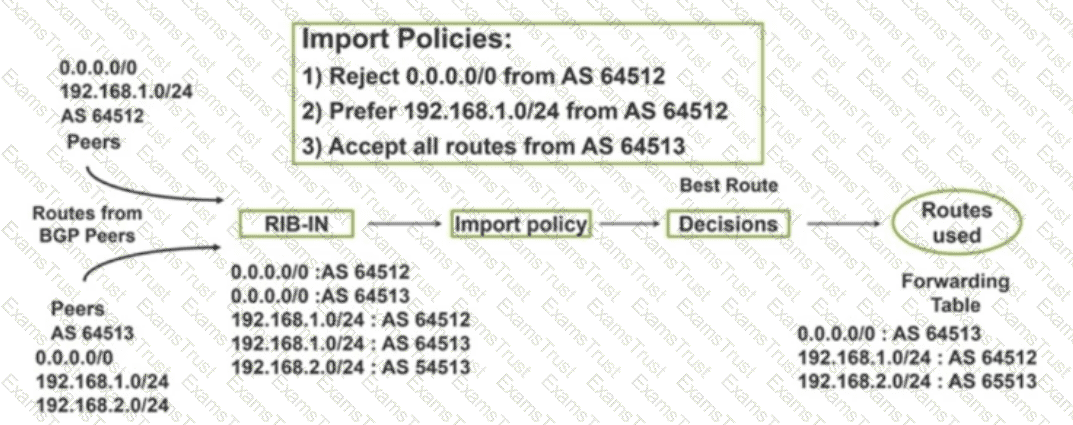
Exhibit.

Referring to the exhibit, you see that the 0.0.0.0/0 route is coming from AS 64512.

What is the command to achieve this task?

Options:

A.

show route receive-protocol bgp

B.

show route protocol bgp source-gateway

C.

show route protocol bgp next-hop < peer ip>

D.

show route receive-protocol bgp hidden

Question 3

You are asked to configure 802.1X on an EX Series switch port that connects to a downstream switch with several devices attached. You must ensure that the first device is authenticated while all subsequent devices are permitted.

What will accomplish this request?

Options:

A.

single supplicant

B.

MAC RADIUS

C.

single-secure supplicant

D.

multiple supplicant

Question 4

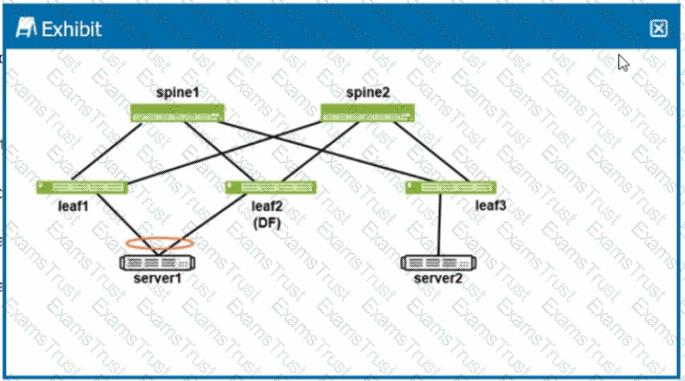
Exhibit.

Referring to the exhibit. Ieaf2 is elected the designated forwarder

Which two statements are correct if server2 generates a broadcast frame*? (Choose two.)

Options:

A.

The broadcast frame will be forwarded to leaf1 and Ieaf2.

B.

The broadcast frame will not be forwarded to leaf1.

C.

Only Ieaf2 will forward the broadcast frame to server1

D.

Only leaf1 will forward the broadcast frame to server1.

Question 5

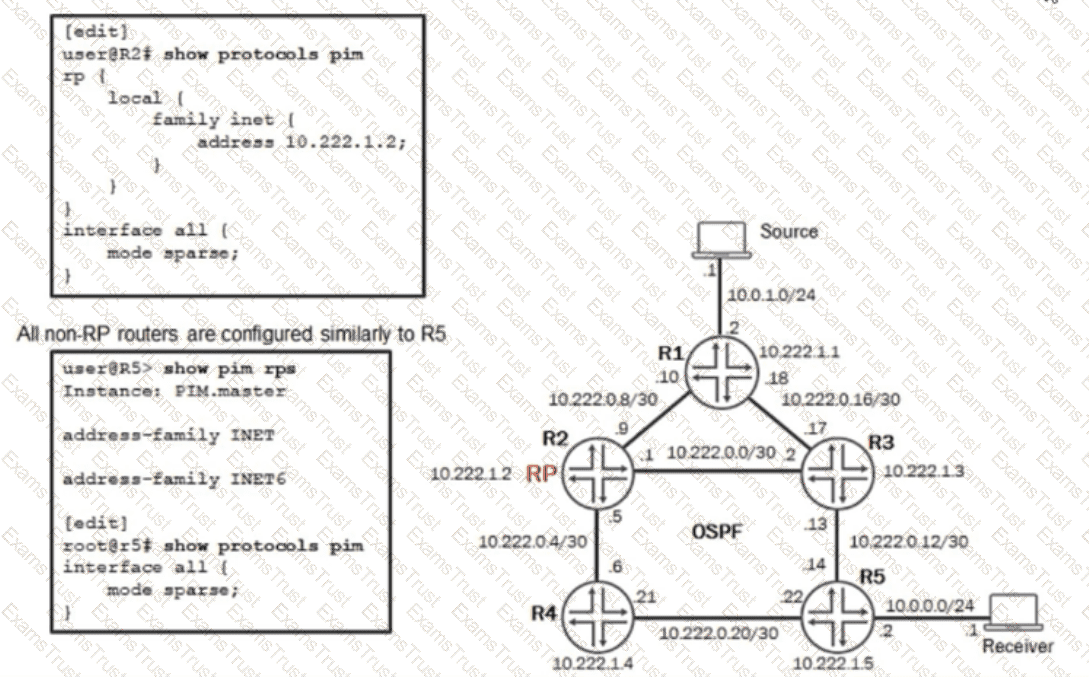
Exhibit

You need to configure the non-RP routers in your network to dynamically learn the location of the RP using standard protocols only. You have already applied the configuration shown in the exhibit, but the routers have not learned the location of the RP.

Which additional step must you take to fulfill these requirements?

Options:

A.

Configure MSDP.

B.

Configure BSR.

C.

Configure Anycast RP.

D.

Configure Auto-RP

Question 6

Which two statements correctly describe how EX Series switches use captive portal for Layer 2 authentication? (Choose two.)

Options:

A.

The captive portal is the default Layer 2 authentication method that is applied before other methods such as 802 1X or MAC RADIUS.

B.

The captive portal authentication allowlist works for devices that do not have HTTP capabilities.

C.

The captive portal is configured on Layer 3 interfaces and does not participate in Layer 2 authentication on EX Series switches.

D.

The captive portal is used as a fallback mechanism for clients that fail 802.1X or MAC RADIUS authentication.

Question 7

You are enabling CoS throughout your enterprise network using the DSCP bits. You plan to use an MF classifier on all edge devices while using BA classifiers on all transit core devices

In this scenario, what should you use to provide consistent handling of traffic?

Options:

A.

You should implement rewrite rules on the edge devices' egress interfaces to rewrite the DSCP bits as it leaves the device toward the core.

B.

You should implement rewrite rules on the edge devices' ingress interfaces to rewrite the DSCP bits as it enters the device.

C.

You should implement rewrite rules on the core devices' ingress interfaces to rewrite the DSCP bits as it enters the device.

D.

You should implement rewrite rules on the core devices' egress interfaces to rewrite the DSCP bits as it leaves the device toward other core devices.

Question 8

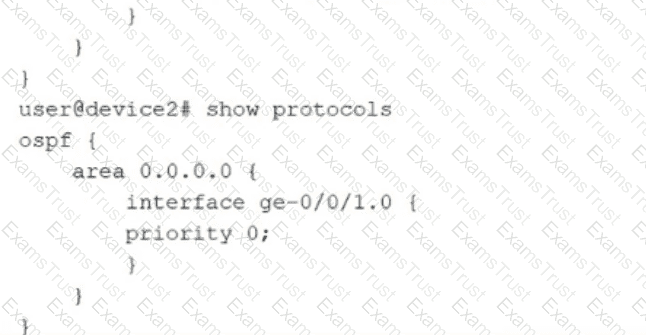
Exhibit.

Referring to the exhibit, which statement is correct?

Options:

A.

The device with the highest IP address is elected as the DR.

B.

The OSPF state will be stuck in the Exstart state

C.

The OSPF state will be stuck in the 2Nay state

D.

The device with the lowest IP address is elected as the DR.

Question 9

You run a multivendor switching environment where you have configured VSTP. You have 450 VLANs and notice that some of your VLANs do not function properly. How should you change the configuration to get all 450 VLANs working?

Options:

A.

Include the force-version stp; statement in your configuration

B.

Enable RSTP to handle additional VLANs.

C.

Set the VLAN max-age to 3600 or more.

D.

Increase the bridge priority on all VLANs to at least 16k.

Question 10

You configured MVRP in your Layer 2 network and you are adding two new interfaces to your distribution switch. You are asked to ensure that if a rogue device that uses MVRP is connected to these interfaces, that the MVRP PDUs are ignored

In this scenario, what should you configure to accomplish this task?

Options:

A.

Configure the join-timer to 500 ms.

B.

Configure the no-dynamic-vlan feature under MVRP.

C.

Configure the two new interfaces as point-to-point.

D.

Configure the two new interfaces under MVRP using the forbidden registration mode.

Question 11

You are deploying IP phones in your enterprise networks. When plugged in. the IP phones must automatically be provided with their geographic location details by the EX Series switches.

In this scenario, which protocol should be used to enable this behavior?

Options:

A.

CDP

B.

LLDP-MED

C.

LLDP

D.

MP-BGP

Question 12

According to IETF standards, which two statements are correct about EVPN/VXLAN deployments? (Choose two.)

Options:

A.

Up to 16 million EVPN broadcast domains can exist.

B.

Up to 16 million VXLAN broadcast domains can exist.

C.

IP packets within the same broadcast domain are forwarded unchanged.

D.

Layer 2 frames within the same broadcast domain are forwarded unchanged.

Question 13

Your organization uses 802 1X with a RADIUS server. If the RADIUS server stops responding, you want the fallback action to continue to permit access for devices that currently have authorization but deny any new access attempts.

Which fallback action provides this capability?

Options:

A.

deny

B.

vlan-name

C.

permit

D.

use-cache

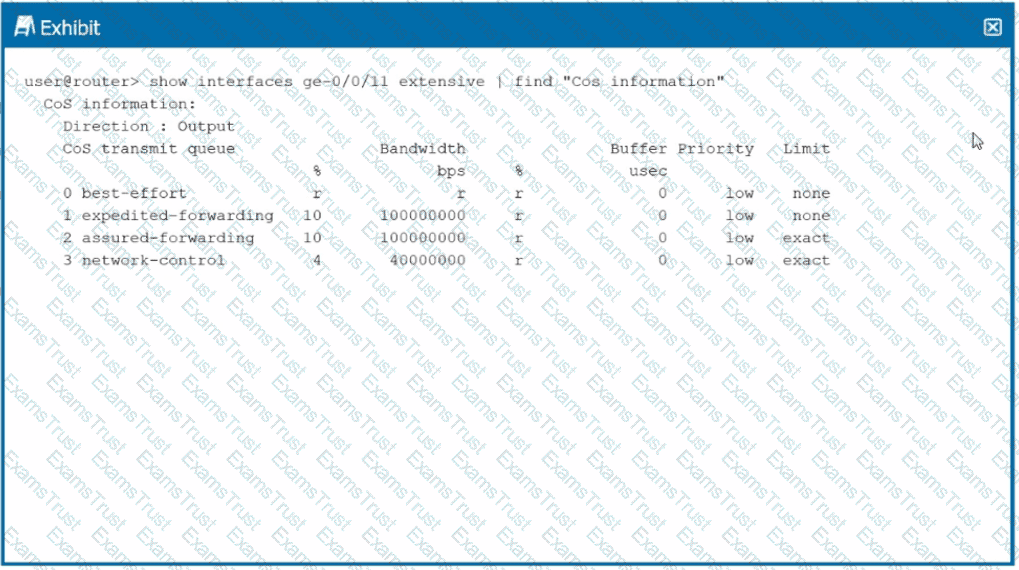
Question 14

Exhibit

Referring to the exhibit, which two statements are correct? (Choose two.)

Options:

A.

The bandwidth reservation for queue 0 is 76%.

B.

During times of no network congestion, traffic that is placed in queue 2 will be dropped if more than 10% of the interface bandwidth is used

C.

The bandwidth reservation for queue 0 is 100%.

D.

During times of sustained network congestion, traffic that is placed in queue 2 will be dropped if more than 10% of the interface bandwidth is used

Question 15

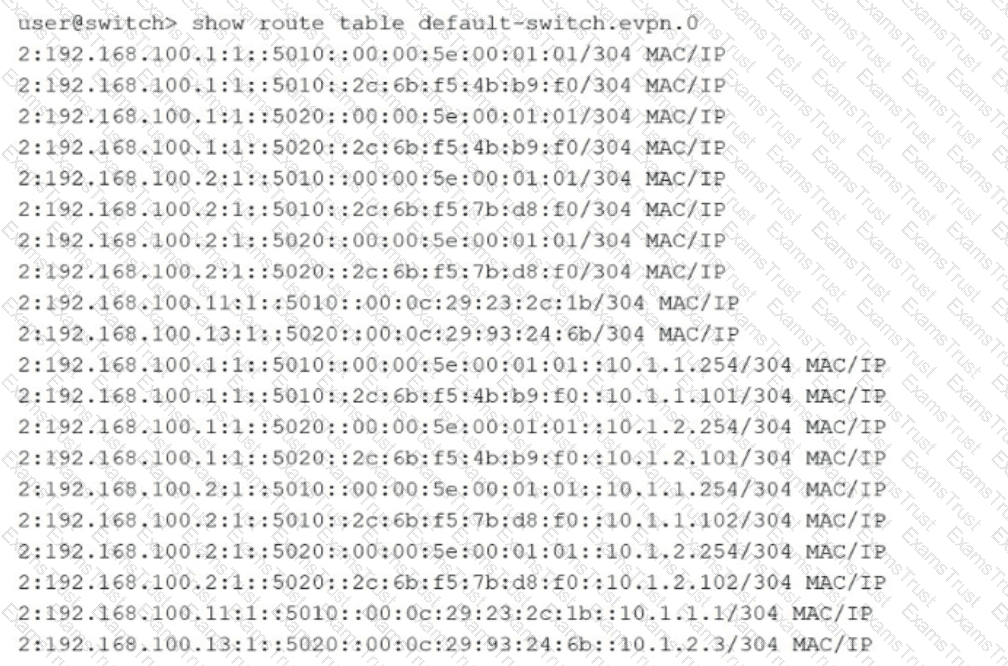
Exhibit

Referring to the exhibit output, which statement is correct?

Options:

A.

The device with an IP address of 192.168.100 2 is attached to VNI 5010

B.

The output shows the router ID of the device sending the EVPN Type 2 routes

C.

The output shows the route distinguisher of the device sending the EVPN Type 2 routes

D.

IP addresses 10.1.1.1 and 10.1 2.3 are connected to the same VNI.

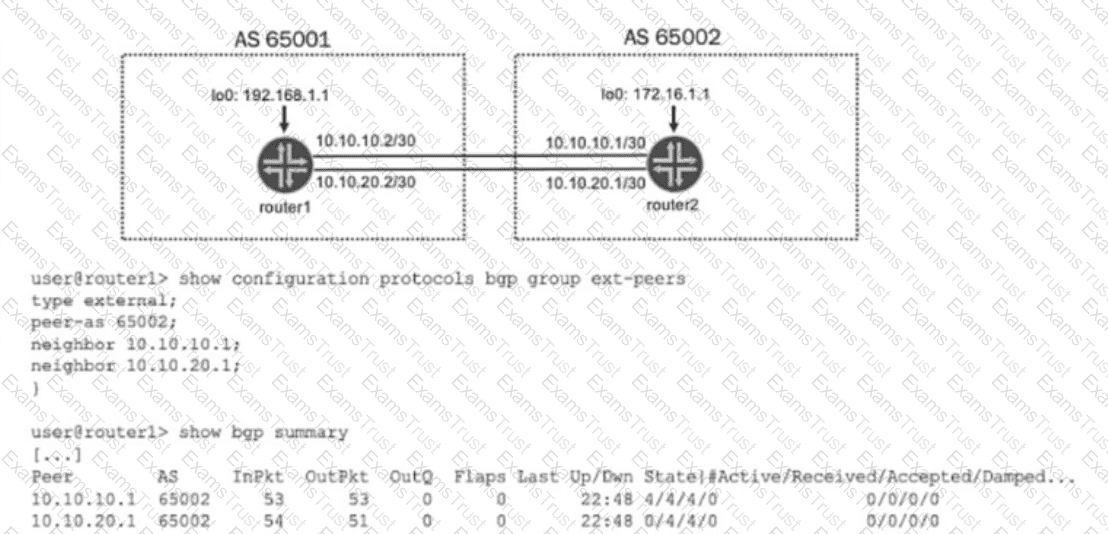
Question 16

Exhibit

Referring to the exhibit, what will enable active routes from both peers?

Options:

A.

Configure neighbor 172.16.1.1 multipath under the ext-peers hierarchy.

B.

Configure multipath under the ext-peers hierarchy

C.

Configure neighbor 172.16.1.1 under the ext-peers hierarchy.

D.

Configure neighbor 10.10.20.2 multipath under the ext-peers hierarchy.

Question 17

You have configured DSCP CoS in your network and have applied BA and multifield classifiers to all interfaces.

In this scenario, which statement is correct?

Options:

A.

If traffic matches both classifiers, then the multifield classifier determines into which forwarding class the traffic is assigned

B.

You must set the BA classifier to take precedence over the multifield classifier or the configuration is ignored

C.

You must set the multifield classifier to take precedence over the BA classifier or the configuration is ignored.

D.

If traffic matches both classifiers, then the BA classifier determines into which forwarding class the traffic is assigned.

Question 18

Your router is discarding an EBGP route because the next hop is not directly connected. Which BGP configuration would you use to override this behavior?

Options:

A.

accept-remote-nexthop

B.

multihop

C.

advertise-inactive

D.

multipath

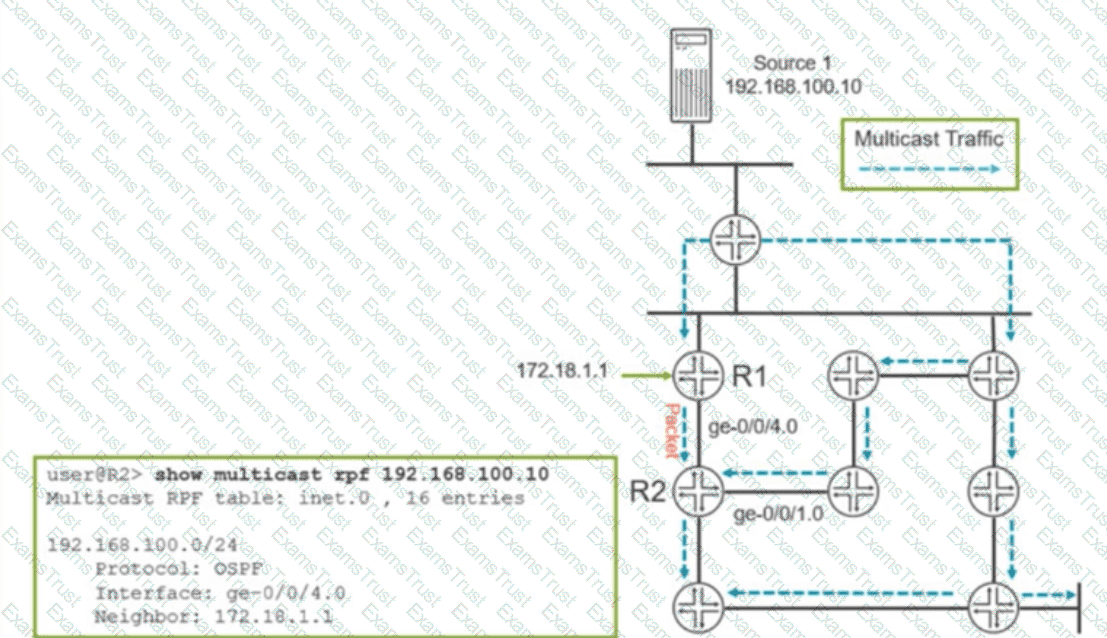
Question 19

Exhibit

Referring to the exhibit. R2 receives a packet from the multicast source on its ge-0/0/4 0 interface.

Which two statements are correct in this scenario? (Choose two.)

Options:

A.

R2 verifies the existing unicast routing table and determines that this interface is not on the reverse path back to the source

B.

All interfaces other than ge-0/0/4.0 will be on the outgoing interface list.

C.

The packet is discarded

D.

R2 determines that the packet is coming in on an interface that is on the reverse path back to the source.

Page: 1 / 7
Total 65 questions