

Which IPv6 extension header is used to specify intermediate nodes for a packet's path?
What are three default BGP advertisement rules? (Choose three.)
What happens if an IS-IS router receives a link-state PDU with a higher sequence number than the one in its database?
You are configuring BGP for IPv6 operations. In this scenario, which two statements are correct? (Choose two.)
You are using EBGP to connect to two upstream peers in the same AS. You want to make one of the links less preferred for traffic entering your network from the peer's AS. Which feature should you use to achieve this goal?
Exhibit:
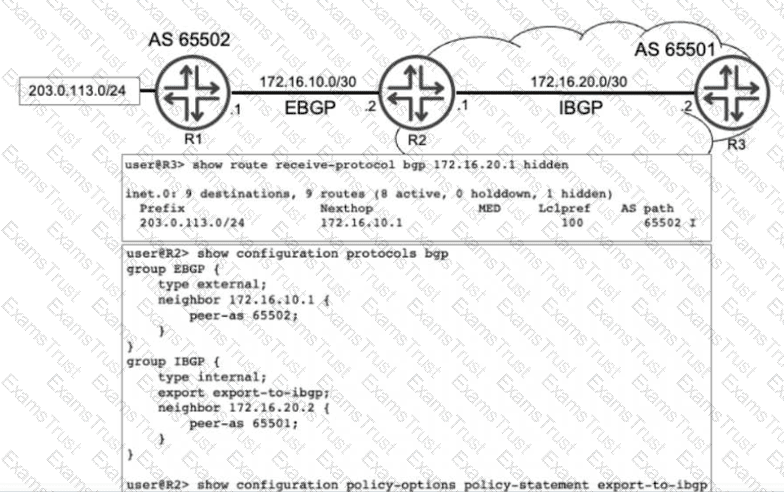
Referring to the exhibit, R1 is advertising prefix 203.0.113.0/24 to R2 over EBGP. R2 is configured to advertise this prefix into IBGP. R3 receives the 203.0.113.0/24 route, however the route is hidden. Which configuration statement do you need to add to R2 to solve this problem?
What are three extension headers supported by IPv6? (Choose three.)
Which two statements regarding GRE and IP-IP tunnels are correct? (Choose two.)
What is the default export behavior of IS-IS in the Junos OS?
In an OSPF network, what is a purpose of a designated router?
You are configuring LDP in a service provider network. After enabling LDP on core interfaces, you notice that labels are being advertised for every loopback IPv4 address that is in your IGP. Which label distribution mode is being used in this scenario?
Exhibit:

Referring to the exhibit, why is the ge-0/0/0.0 interface shown as belonging to Level 3?
Exhibit:
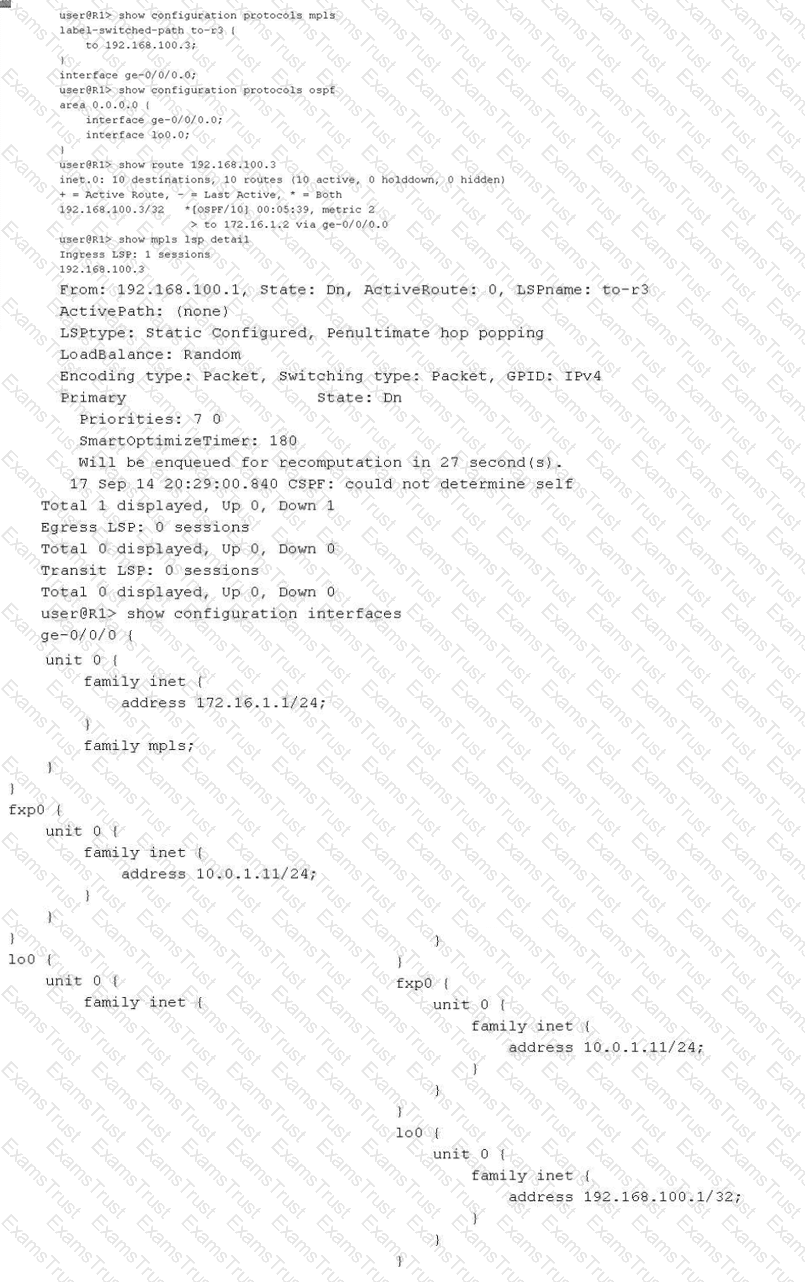
You have configured an MPLS LSP to 192.168.100.3. However, the LSP is in the down state. Referring to the exhibit, which two actions would solve this problem? (Choose two.)
A BGP router receives two routes to the same prefix. One route has a higher local preference, while the other has a shorter AS path. In this scenario, which route would be selected?
Exhibit:
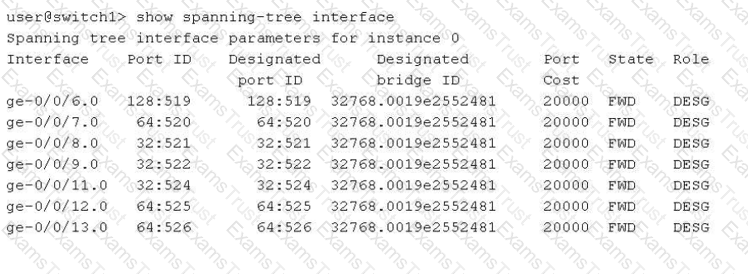
Referring to the exhibit, which two statements are correct? (Choose two.)
Exhibit:
user@R10> show configuration protocols isis
interface ge-0/0/1.0 {
point-to-point;
}
interface ge-0/0/2.0 {
point-to-point;
}
interface lo0.0;
source-packet-routing {
srgb start-label 300000 index-range 10000;
}
level 1 disable;
level 2 wide-metrics-only;
reference-bandwidth 100g;
You have a network of ten routers that have all been configured with an identical SRGB. The exhibit shows the IS-IS configuration from a router called R10. The other nine routers do not yet have an IPv4 shortest-path SR-MPLS LSP to this router. Which missing part of the configuration must you add on R10 to solve this problem?
A service provider is onboarding a new enterprise customer that operates multiple branch offices, each with its own set of VLANs. The customer requires transparent Layer 2 connectivity between sites while maintaining separation of internal VLANs. The provider must also ensure that customer VLAN identifiers do not conflict with other customers on the shared infrastructure. Which solution would provide the desired results?
You are designing a high availability solution for a Juniper router with dual Routing Engines (RE). You want to ensure that the routing protocol state is preserved during an RE switchover. You have already enabled graceful Routing Engine switchover (GRES) and you want to avoid relying on helper routers to maintain the routing protocol state. In this scenario, which feature would accomplish this behavior?
During OSPF neighbor establishment, which packet type is used to describe the contents of the link-state database?