
Winter Sale Flat 65% Limited Time Discount offer - Ends in 0d 00h 00m 00s - Coupon code: netdisc

Huawei H12-841_V1.5 HCIP-Datacom-Campus Network Planning and Deployment V1.5 Exam Practice Test

Page: 1 / 10
Total 104 questions

HCIP-Datacom-Campus Network Planning and Deployment V1.5 Questions and Answers

Testing Engine

  • Product Type: Testing Engine
$43.75  $124.99

PDF Study Guide

  • Product Type: PDF Study Guide
$38.5  $109.99
Question 1

(Which of the following statements isfalseabout sites on a virtualized network deployed using iMaster NCE-Campus?)

Options:

A.

iMaster NCE-Campus does not support batch site creation.

B.

Tenants configure and manage devices by site.

C.

iMaster NCE-Campus allows administrators to create sites one by one.

D.

A site is a tenant network created by a tenant administrator.

Question 2

(Which of the following are the typical deployment scenarios when iMaster NCE-Campus is used to deploy a network?)

Options:

A.

Campus network

B.

VXLAN Fabric network

C.

Branch network

D.

Small-sized network

Question 3

(An administrator monitors the network status on iMaster NCE-Campus. The figure shows alarm information displayed on iMaster NCE-Campus. How manywarning alarmsare generated on the network?)

Options:

A.

0

B.

1

C.

5

D.

10

Question 4

(Huawei CloudEngine S series switches can provide PoE using Cat5e cables over a distance of up to 200 m.)

Options:

A.

TRUE

B.

FALSE

Question 5

(An MSP administrator creates a tenant account. Which of the following logs records the operation?)

Options:

A.

Operation Log

B.

System Log

C.

Security Log

D.

Device Channel Log

Question 6

(What are the respective protocol numbers of AH and ESP?)

Options:

A.

6 and 17

B.

51 and 50

C.

50 and 51

D.

17 and 57

Question 7

(Which of the following can be used to classify campus networks?)

Options:

A.

Network scale

B.

Served objects

C.

Access mode

D.

Service complexity

Question 8

(Based on the VXLAN tunnel creation mode, what are the different types of VXLAN tunnels?)

Options:

A.

Stateless VXLAN tunnel

B.

Static VXLAN tunnel

C.

Dynamic VXLAN tunnel

D.

Stateful VXLAN tunnel

Question 9

(In the Huawei CloudCampus Solution, which of the following provisioning modes isnot supportedby firewalls?)

Options:

A.

Web interface

B.

Registration center query

C.

DHCP Option 148

D.

CLI

Question 10

(The Huawei CloudCampus Solution divides the network architecture into three layers: network layer, management layer, and application layer.)

Options:

A.

TRUE

B.

FALSE

Question 11

(When a BGP EVPN route is transmitted between VTEPs, the BGP EVPN route is discarded only when the RT carried in the route is different from both the EVPN IRT and IP VPN IRT.)

Options:

A.

TRUE

B.

FALSE

Question 12

(Which of the following rate limiting modes are supported by the Huawei CloudCampus Solution in small- and medium-sized campus scenarios?)

Options:

A.

Radio-based rate limiting

B.

ACL-based rate limiting

C.

SSID-based rate limiting

D.

User-based rate limiting

Question 13

(ESP is an IP-based transport-layer protocol. Which of the following is its protocol number?)

Options:

A.

47

B.

50

C.

51

D.

102

Question 14

(On a small- or medium-sized campus network deployed based on the Huawei CloudCampus Solution, if a single AP is used as the network egress and needs to be managed by iMaster NCE-Campus, in which of the following modes should the AP work?)

Options:

A.

RU

B.

Fit

C.

Cloud

D.

Fat

Question 15

(When configuring access authentication, you need to define the items authorized to users in the authorization result. Which of the following items does not need to be defined?)

Options:

A.

VLAN

B.

IP address

C.

Security group

D.

ACL

Question 16

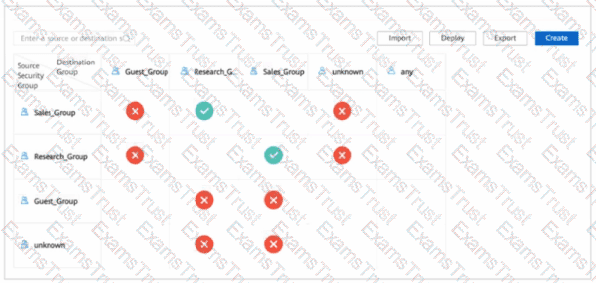
(The following figure shows a policy control matrix on a virtualized network deployed using iMaster NCE-Campus. Which of the following statements about the policy control matrix are true?Choose all that apply.)
Options:

A.

Users in Guest_Group cannot communicate with those in Research_Group.

B.

Users within Sales_Group can communicate with each other.

C.

If a user is not within Guest Group, Research Group, or Sales Group, that user cannot access any network resources.

D.

Users in Research_Group cannot communicate with those in Guest_Group.

Question 17

(On a virtualized network deployed using iMaster NCE-Campus, which of the following methods can be used by a network administrator during VN creation to create user network segments?)

Options:

A.

Manually create them one by one.

B.

Import them in a batch using a template.

C.

Directly invoke the user network segments in the global resource pool of the fabric.

D.

Create them in a batch through automatic allocation.

Question 18

(Which of the following encapsulation modes are supported in IPsec?)

Options:

A.

Switching mode

B.

Tunnel mode

C.

Transport mode

D.

Routing mode

Question 19

(Which of the following is not an advantage of Huawei CloudCampus solution?)

Options:

A.

Supports automatic deployment of physical networks

B.

Supports plug-and-play of devices

C.

Unified management of Huawei switches, routers, and storage servers

D.

Supports free mobility

Question 20

(Huawei switches support VLAN assignment based on interface, MAC address, protocol, and IP address.)

Options:

A.

TRUE

B.

FALSE

Question 21

(Which of the following functions isnot supportedby AH?)

Options:

A.

Anti-replay

B.

Data origin authentication

C.

Data integrity check

D.

Data encryption

Question 22

(Which of the following statements about the fabric global resource pool isfalse?)

Options:

A.

A bridge domain is a Layer 2 broadcast domain used to forward data packets on a VXLAN.

B.

VLANs for connecting to external networks, VLANs for connecting to network service resources, and VLANs for connecting underlay devices are allocated from the VLAN resource pool.

C.

A VXLAN network identifier identifies a VXLAN.

D.

Configure a service VLAN pool when you need to configure external gateway interconnection VLANs, network service resource interconnection VLANs, management VLANs for policy association, and VN access VLANs.

Question 23

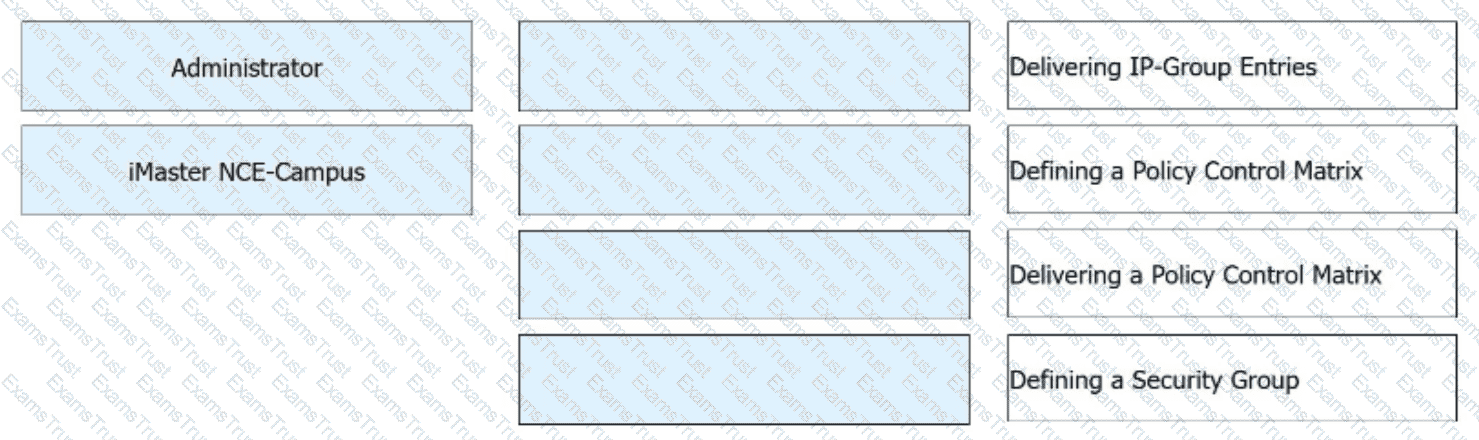
Free mobility is deployed on a campus network through iMaster NCE-Campus. During this deployment, which of the following steps are performed by administrators and which are automatically performed by iMaster NCE-Campus?
Options:

Question 24

(Free mobility implements policy management and permission control based on users' VLAN IDs and IP addresses.)

Options:

A.

TRUE

B.

FALSE

Question 25

(Which of the following technologies can be used to isolate users in the same VLAN, enhance user communication security, and prevent invalid broadcast packets from affecting services?)

Options:

A.

Super VLAN

B.

Port isolation

C.

IPSG

D.

Ethernet port security

Question 26

(Fabric nodes need to be planned during fabric design on a CloudCampus virtualized campus network. Which of the following statements about node planning on a fabric is false?)

Options:

A.

It is recommended that core devices be deployed as border nodes, and access or aggregation devices be deployed as edge nodes.

B.

It is recommended that access devices be deployed as edge nodes to implement end-to-end automatic VXLAN deployment.

C.

When the fabric needs to connect to two external networks located in different physical locations, two border nodes need to be deployed.

D.

If a BGP EVPN RR is required on a VXLAN network, BGP peer relationships need to be established between edge nodes and border nodes and between edge nodes.

Question 27

(On the Device Management page of iMaster NCE-Campus, which of the following functions will automatically enable the SSH proxy tunnel of the network device?)

Options:

A.

Summary

B.

Entry Query

C.

Device Configuration

D.

Command Line

Question 28

(On a small- or medium-sized campus network, multi-carrier links can be deployed at the egress for backup to ensure egress reliability.)

Options:

A.

TRUE

B.

FALSE

Question 29

(Which of the following negotiation modes are supported in IKEv1 negotiation phase 1?)

Options:

A.

Normal mode

B.

Main mode

C.

Aggressive mode

D.

Quick mode

Question 30

(On a campus network, which of the following address allocation modes is recommended to facilitate management of devices such as servers, print servers, and video surveillance devices?)

Options:

A.

Dynamic IP address allocation through DHCP

B.

Address binding during PPPoE authentication

C.

Dynamic IP address allocation through the BOOT protocol

D.

Static address allocation through DHCP based on MAC addresses

Question 31

(Which of the following is not one of the three roles defined in policy association?)

Options:

A.

Access device

B.

Portal server

C.

Terminal

D.

Control device

Page: 1 / 10
Total 104 questions