
Month end Sale Limited Time 70% Discount Offer - Ends in 0d 00h 00m 00s - Coupon code: 70special

Fortinet NSE7_CDS_AR-7.6 Fortinet NSE 7 - Public Cloud Security 7.6.4 Architect Exam Practice Test

Fortinet NSE 7 - Public Cloud Security 7.6.4 Architect Questions and Answers

Testing Engine

  • Product Type: Testing Engine
$37.5  $124.99

PDF Study Guide

  • Product Type: PDF Study Guide
$33  $109.99
Question 1

Refer to the exhibit.
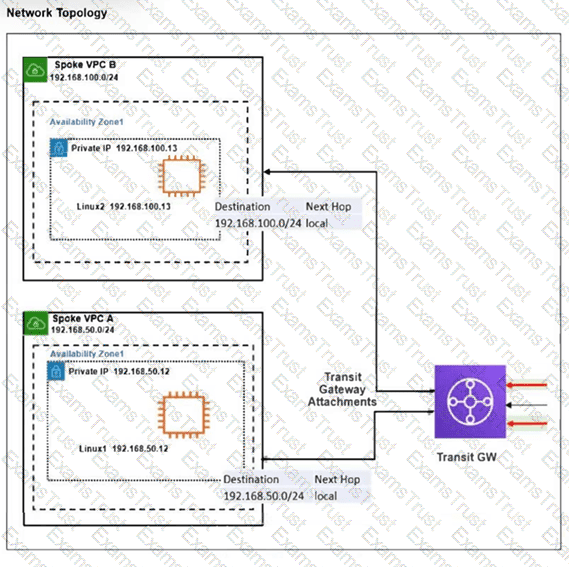
The exhibit shows a customer deployment of two Linux instances and their main routing table in Amazon Web Services (AWS). The customer also created a Transit Gateway (TGW) and two attachments. Which two steps are required to route traffic from Linux instances to the TGW? (Choose two answers)

Options:

A.

In the main subnet routing table in VPC A and B, add a new route with destination 0.0.0.0/0, next hop TGW.12

B.

In the TGW route table, associate two attachments.34

C.

In the TGW route table, add route propagation to 192.168.0.0/16.56

D.

In the main subnet routing table in VPC A and B, add a new route with7 destination 0.0.0.0/0, next hop Internet 8gateway (IGW).

Question 2

Refer to the exhibit.

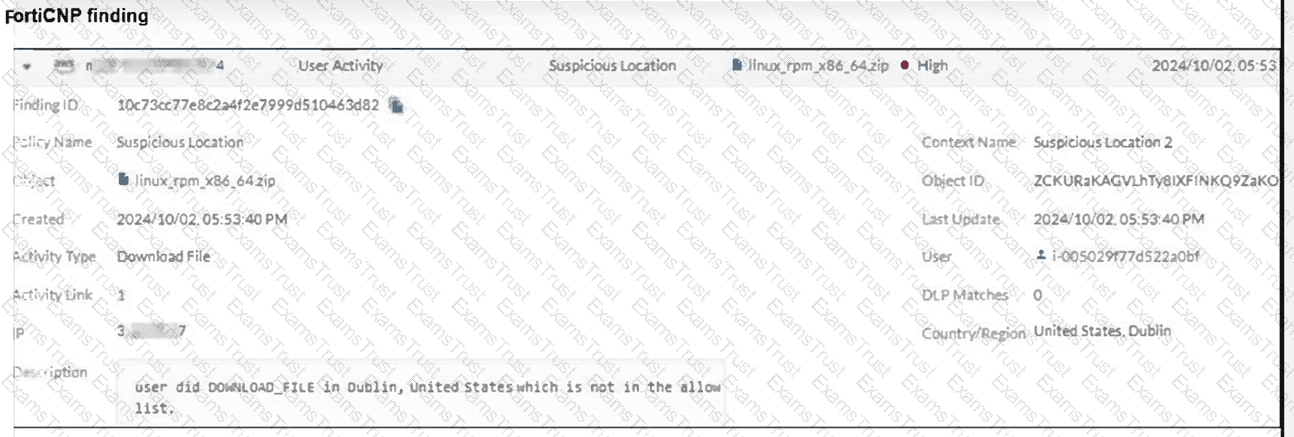
Which FortiCNP policy type generated the finding shown in the exhibit? (Choose one answer)

Options:

A.

This finding was generated by a data scan policy.

B.

This finding was generated by a threat detection policy.

C.

This finding was generated by a risk management policy.

D.

This finding was generated by a file collection policy.

Question 3

Refer to the exhibit.

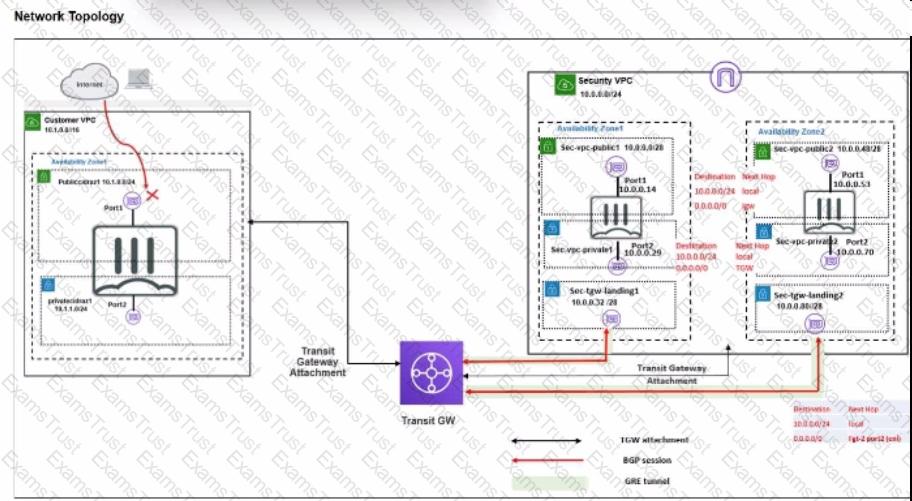
In your Amazon Web Services (AWS), you must allow inbound HTTPS access to the Customer VPC FortiGate VM from the internet. However, your HTTPS connection to the FortiGate VM in the Customer VPC is not successful.

Also, you must ensure that the Customer VPC FortiGate VM sends all the outbound Internet traffic through the Security VPC.

How do you correct this issue with minimal configuration changes? (Choose three.)

Options:

A.

Add a route with your local internet public IP address as the destination and the internet gateway as the target.

B.

Add a route with your local internet public IP address as the destination and the transit gateway as the target.

C.

Add a route to the destination 0.0.0.0/0 with the transit gateway as the target.

D.

Deploy an internet gateway, associate an EIP with the Customer VPC private subnet, and then add a new route with destination 0.0.0.0/0 with the internet gateway as the target.

E.

Deploy an internet gateway, attach it to the Customer VPC, and then associate an EIP with the port1 of the FortiGate in the Customer VPC.

Question 4

Refer to the exhibit.

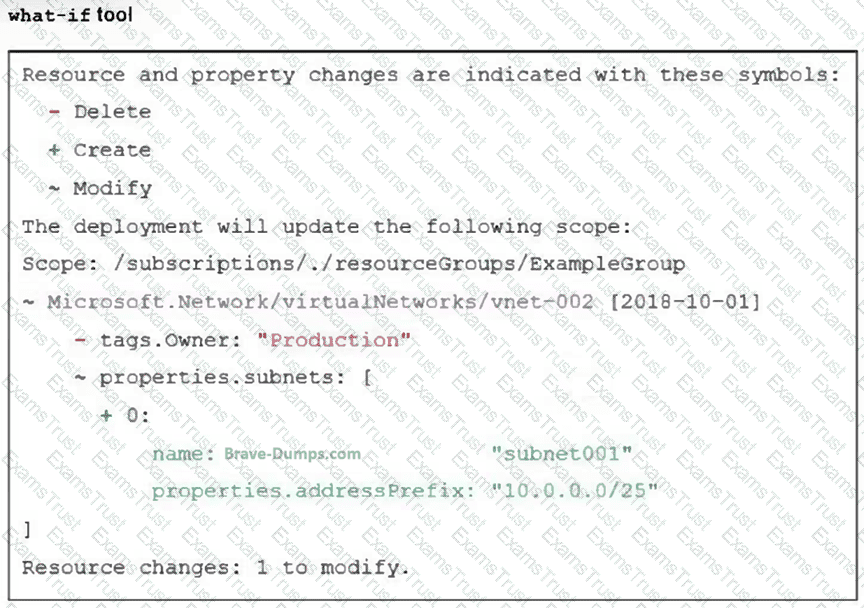
An administrator used the what-if tool to preview the changes to an Azure Bicep file. What will happen if the administrator applies these changes in Azure? (Choose one answer)

Options:

A.

A new subnet will be added to vnet-002.

B.

The vnet-002 VNet will be renamed Production.

C.

The resulting VNet will have a single subnet.

D.

The VNet address space will be updated.

Question 5

A Network security administrator is searching for a solution to secure traffic going in and out of the container infrastructure.

In which two ways can Fortinet container security help secure container infrastructures? (Choose two.)

Options:

A.

FortiGate NGFW can inspect north-south container traffic with label aware policies.

B.

FortiGate NGFW and FortiWeb can be used to secure container traffic.

C.

FortiGate NGFW can connect to the worker nodes and protect the containers.

D.

FortiGate NGFW can be placed between each application container for north-south traffic inspection.

Question 6

A customer would like to use FortiGate fabric integration with FortiCNP. When adding a FortiGate VM to FortiCNP, which three mandatory configuration steps must you follow on FortiGate? (Choose three answers)

Options:

A.

Enable pre-shared key on both sides.

B.

Import the FortiGate certificate into FortiCNP.

C.

Configure FortiGate to send logs to FortiCNP.

D.

Create an IPS sensor and a firewall policy.

E.

Create an SSL/SSH inspection profile.

Question 7

Refer to the exhibit.

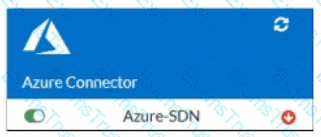
You are troubleshooting a Microsoft Azure SDN connector issue on your FortiGate VM in Azure.

Which command can you use to examine details about API calls sent by the connector?

Options:

A.

diag debug application cloud-connector -1

B.

diag test application azd 1

C.

diag debug application azd -1

D.

get system sdn-connector

Question 8

You must add an Amazon Web Services (AWS) network access list (NACL) rule to allow SSH traffic to a subnet for temporary testing purposes. When you review the current inbound and outbound NACL rules, you notice that the rules with number 5 deny SSH and telnet traffic to the subnet.

What can you do to allow SSH traffic?

Options:

A.

You do not have to create any NACL rules because the default security group rule automatically allows SSH traffic to the subnet.

B.

You must create a new allow SSH rule anywhere in the network ACL rule base to allow SSH traffic.

C.

You must create two new allow SSH rules, each with a number bigger than 5.

D.

You must create two new allow SSH rules, each with a number smaller than 5.

Question 9

What are two main features in Amazon Web Services (AWS) network access control lists (NACLs)? (Choose two answers)

Options:

A.

NACLs are stateless, and inbound and outbound rules are used for traffic filtering.

B.

NACLs are tied to an instance.

C.

The default NACL is configured to allow all traffic.

D.

You cannot use NACLs and Security Groups at the same time.

Question 10

Refer to the exhibit.

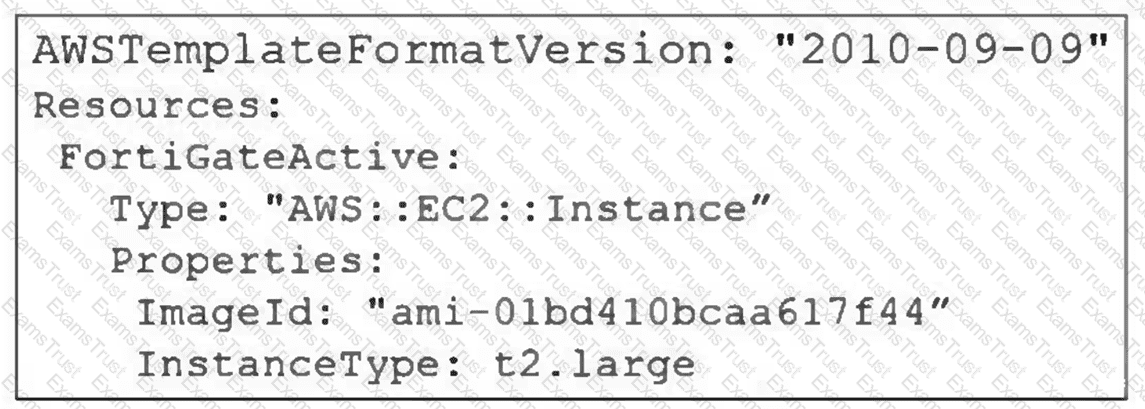
A senior administrator in a multinational organization needs to include a comment in the template shown in the exhibit to ensure that administrators from other regions change the EC2 instance size value to one that meets the requirements in their local deployments. How can the administrator add the comment in that section of the file? (Choose one answer)

Options:

A.

The administrator can run the aws cloudformation update-stack and include the comment.

B.

The administrator must update the AWSTemplateFormatVersion to a more current version.

C.

The administrator must convert the template to JSON format before adding the comment.

D.

The administrator can add the comment with the # character next to the InstanceType section.

Question 11

Refer to the exhibit.

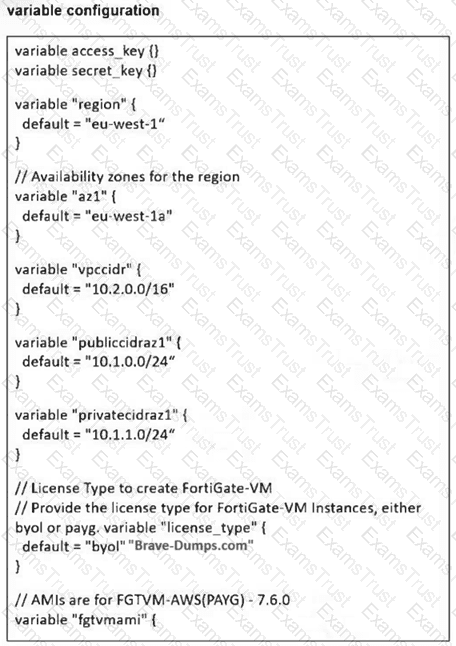
You are tasked to deploy a FortiGate VM with private and public subnets in Amazon Web Services (AWS). You examined the variables.tf file. Assume that all the other terraform files are in place. What will be the final result after running the terraform init and terraform apply commands? (Choose one answer)

Options:

A.

Terraform will not deploy a FortiGate VM.

B.

Terraform will deploy a FortiGate VM in the eu-West-1a availability zone without any subnets.

C.

Terraform will deploy a FortiGate VM in the eu-West-1 region with private and public subnets.

D.

Terraform will deploy a FortiGate VM in the eu-West-1a availability zone with two subnets and BYOL license.

Question 12

You are experiencing intermittent connectivity issues in a FortiGate HA cluster deployed with Azure gateway load balancer. Traffic is being dropped when it passes through the cluster. What is the cause of the issue? (Choose one answer)1

Options:

A.

The FortiGate firewalls are using the default maximum transmission unit (M2TU) size supported by Azure.

B.

The Azure gateway load balancer is configured with an incorrect health probe port.

C.

The Azure gateway load balancer is blocking large packets, causing traffic failures.

D.

The protected VMs are running an application that fragments packets.

Question 13

An AWS administrator must ensure that each member of the cloud deployment team has the correct permissions to deploy and manage resources using CloudFormation. The administrator is researching which tasks must be executed with CloudFormation and therefore require CloudFormation permissions.

Which task is run using CloudFormation?

Options:

A.

Deploying a new pod with a service in an Elastic Kubernetes Service (EKS) cluster using the kubectl command

B.

Installing a Helm chart to deploy a FortiWeb ingress controller in an EKS cluster

C.

Creating an EKS cluster with the eksctl create cluster command

D.

Changing the number of nodes in a EKS cluster from AWS CloudShell

Question 14

An administrator implements FortiWeb ingress controller to protect containerized web applications in an AWS Elastic Kubernetes Service (EKS) cluster.
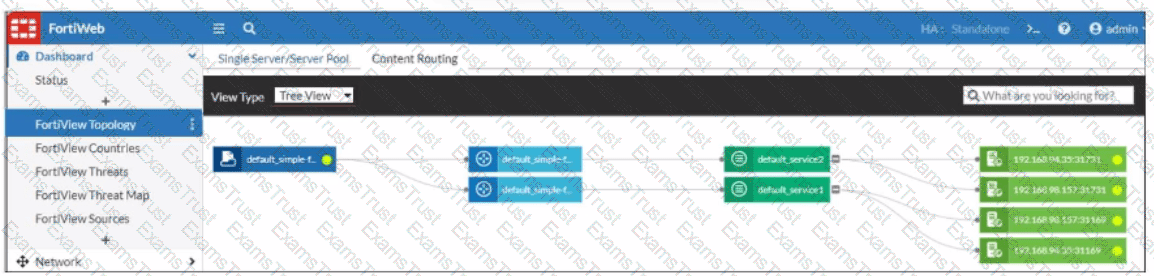
What can you conclude about the topology shown in FortiView?

Options:

A.

The FortiWeb VM gets the latest cluster information through an SDN connector.

B.

This topology has two services and two ingress controllers deployed.

C.

Both services will be load balanced among the two nodes and the four pods.

D.

Adding a new service will update the FortiWeb configuration automatically.

Question 15

Your monitoring team reports performance issues with a web application hosted in Azure. You suspect that the bottleneck might be due to unexpected inbound traffic spikes.

Which method should you use to identify and analyze the traffic pattern?

Options:

A.

Deploy Azure Firewall to log traffic by IP address.

B.

Enable Azure DDoS protection to prevent inbound traffic spikes.

C.

Use Azure Traffic Manager to visualize all traffic to the application.

D.

Enable NSG Flow Logs and analyze logs with Azure Monitor.

Question 16

Refer to the exhibit.

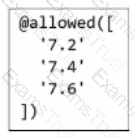
What is the purpose of this section of an Azure Bicep file?

Options:

A.

To restrict which FortiOS versions are accepted for deployment

B.

To indicate the correct FortiOS upgrade path after deployment

C.

To add a comment with the permitted FortiOS versions that can be deployed

D.

To document the FortiOS versions in the resulting topology