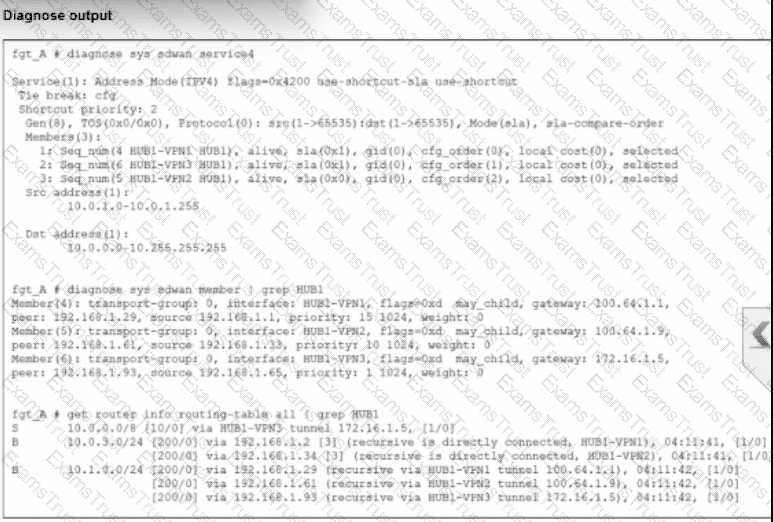
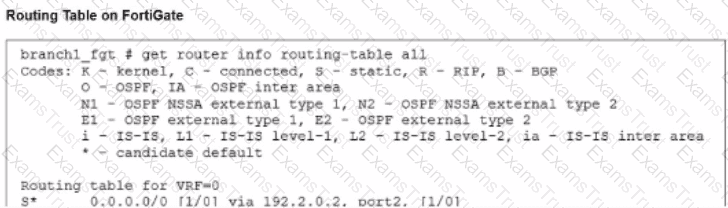
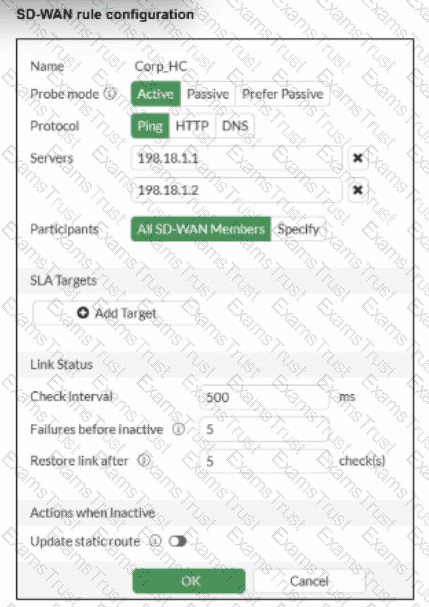
In theSD-WAN 7.6 Core Administratorcurriculum, the "Prefer Passive" probe mode is a hybrid monitoring strategy designed to minimize the overhead of synthetic traffic (probes) while maintaining link health visibility. According to theFortiOS 7.6 Administration Guideand theSD-WAN Study Guide, the behavior and impacts are as follows:
TCP Traffic Requirement (Option E):Passive monitoring relies on the FortiGate’s ability to inspect actual user traffic to calculate health metrics such as Latency, Jitter, and Packet Loss. Specifically, it usesTCP traffic(by analyzing TCP sequence numbers and timestamps to calculate Round Trip Time - RTT). If user traffic is flowing through the member interface, the FortiGate uses those real-world sessions for SLA calculations instead of sending its own probes.
Inability to Detect Dead Members (Option C):A significant limitation of passive monitoring is that it cannot distinguish between a "dead" link and an "idle" link. If there is no traffic, the passive monitor has no data to analyze. Consequently, while in passive mode, the SD-WAN enginecannot detect a dead member. To mitigate this, "Prefer Passive" includes a fail-safe: if no traffic is detected for a specific period (typically3 minutes), the FortiGate will automatically switch toActive mode(sending ICMP/TCP pings) to verify if the link is actually alive.
Why other options are incorrect:
Option A:Passive monitoring generallydisables hardware offloading (ASIC)for the monitored traffic. This is because the CPU must inspect every packet header to calculate performance metrics; if the traffic were offloaded to the Network Processor (NP), the CPU would not see the packets, rendering passive monitoring impossible.
Option B:While active probes often use ICMP,passive monitoringis specifically designed forTCP trafficbecause the TCP protocol's ACK structure allows for accurate RTT and loss calculation without synthetic packets.
Option D:The "3-minute" timer is actually the trigger to switchfrom passive to activewhen traffic is absent, not the fallback timer to return to passive. The fallback to passive happens as soon as valid TCP traffic is detected again.
According to theFortiSASE 7.6 Administration Guideand theFCP - FortiSASE 24/25 Administratorstudy materials, FortiSASE supports three primary external (remote) authentication sources to verify the identity of remote users (SIA and SPA users). These sources allow organizations to leverage their existing identity infrastructure for seamless onboarding and policy enforcement:
Security Assertion Markup Language (SAML) (Option A):This is the most common and recommended method for modern SASE deployments. FortiSASE acts as aSAML Service Provider (SP)and integrates withIdentity Providers (IdP)such as Microsoft Entra ID (formerly Azure AD), Okta, or FortiAuthenticator. This enables Single Sign-On (SSO) and Multi-Factor Authentication (MFA).
Lightweight Directory Access Protocol (LDAP) (Option C):FortiSASE can connect to on-premises or cloud-based LDAP servers (such as Windows Active Directory). This allows the administrator to map existing AD groups to FortiSASE user groups for granular security policy application.
Remote Authentication Dial-in User Service (RADIUS) (Option E):RADIUS is supported for organizations that use centralized authentication servers or traditional MFA solutions (like RSA SecurID). FortiSASE can query a RADIUS server to validate user credentials before granting access to the SASE tunnel.
Why other options are incorrect:
OpenID Connect (OIDC) (Option B):While OIDC is a modern authentication protocol similar to SAML, FortiSASE's primary integration for external Identity Providers is currently standardized onSAML 2.0.
TACACS+ (Option D):Terminal Access Controller Access-Control System Plus is primarily used foradministrative access(AAA) to network devices (like logging into a FortiGate CLI or FortiManager). It is not used for end-user VPN or SASE authentication in the Fortinet ecosystem.