
Week end Sale Limited Time 70% Discount Offer - Ends in 0d 00h 00m 00s - Coupon code: 70special

Fortinet NSE4_FGT_AD-7.6 Fortinet NSE 4 - FortiOS 7.6 Administrator Exam Practice Test

Fortinet NSE 4 - FortiOS 7.6 Administrator Questions and Answers

Testing Engine

  • Product Type: Testing Engine
$37.5  $124.99

PDF Study Guide

  • Product Type: PDF Study Guide
$33  $109.99
Question 1

Which three statements about SD-WAN performance SLAs are true? (Choose three.)

Options:

A.

They rely on session loss and jitter.

B.

They monitor the state of the FortiGate device.

C.

All the SLA targets can be configured.

D.

They are applied in a SD-WAN rule lowest cost strategy.

E.

They can be measured actively or passively.

Question 2

Refer to the exhibits.

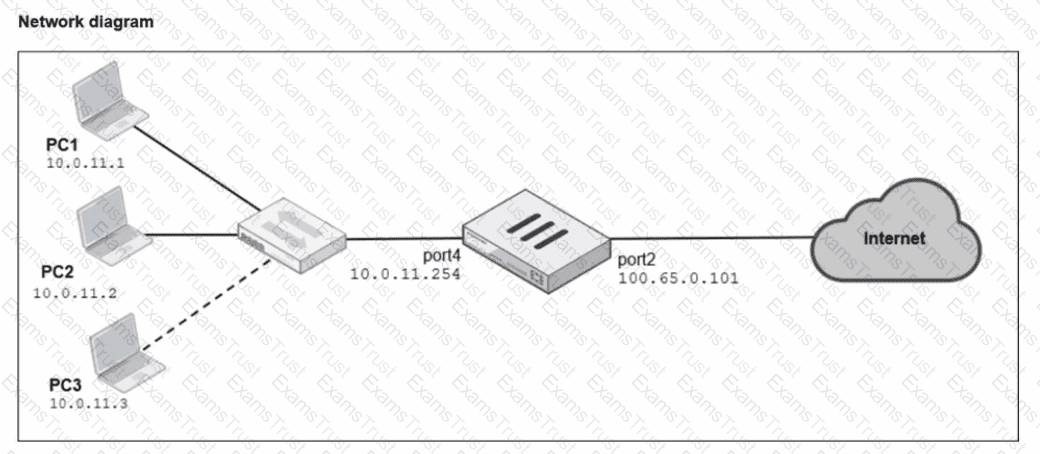
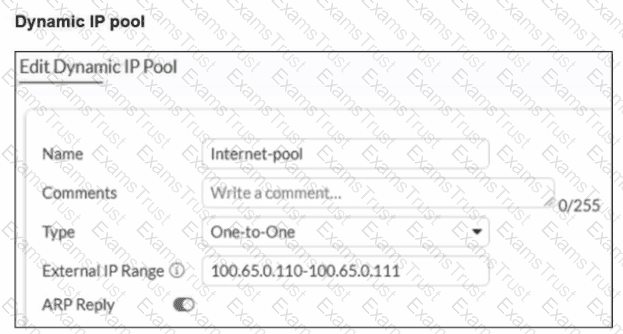
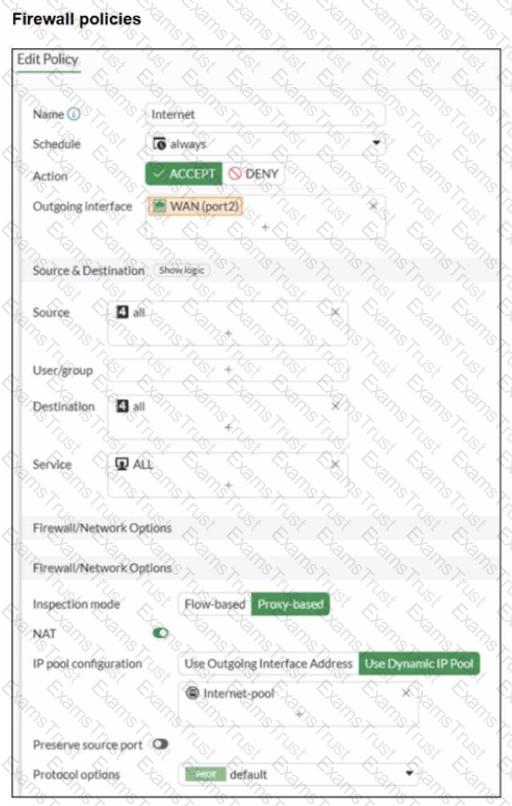
A diagram of a FortiGate device connected to the network, as well as the firewall policy and IP pool configuration on the FortiGate device are shown.

Two PCs. PC1 and PC2, are connected behind FortiGate and can access the internet successfully. However, when the administrator adds a third PC to the network (PC3), the PC cannot connect to the internet.

Based on the information shown in the exhibit, which two configuration options can the administrator use to fix the connectivity issue for PC3? (Choose two.)

Options:

A.

In the system settings, set Multiple Interface Policies to enable.

B.

in the IP pool configuration, set end ipto 100.65.0.112.

C.

In the firewall policy, set match-vip to enable using CLI.

D.

In the IP pool configuration, set type to overload.

Question 3

Which three statements explain a flow-based antivirus profile? (Choose three answers)

Options:

A.

FortiGate buffers the whole file but transmits to the client at the same time.

B.

Flow-based inspection uses a hybrid of the scanning modes available in proxy-based inspection.

C.

If a virus is detected, the last packet is delivered to the client.

D.

Flow-based inspection optimizes performance compared to proxy-based inspection.

E.

The IPS engine handles the process as a standalone.

Question 4

An administrator wanted to configure an IPS sensor to block traffic that triggers the signature set number of times during a specific time period. How can the administrator achieve the objective?

Options:

A.

Use IPS group signatures, set rate-mode 60.

B.

Use IPS packet logging option with periodical filter option.

C.

Use IPS signatures, rate-mode periodical option.

D.

Use IPS filter, rate-mode periodical option.

Question 5

A network administrator has enabled full SSL inspection and web filtering on FortiGate. When visiting any HTTPS websites, the browser reports certificate warning errors. When visiting HTTP websites, the browser does not report errors.

What is the reason for the certificate warning errors?

Options:

A.

The option invalid SSL certificates is set to allow on the SSL/SSH inspection profile.

B.

The matching firewall policy is set to proxy inspection mode.

C.

The browser does not trust the certificate used by FortiGate for SSL inspection.

D.

The certificate used by FortiGate for SSL inspection does not contain the required certificate extensions.

Question 6

Refer to the exhibit showing a debug flow output.
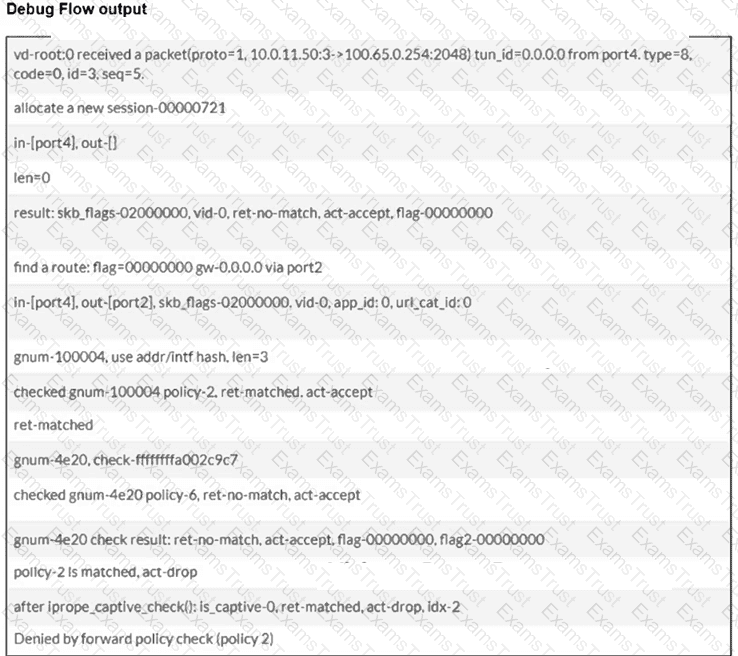
Which two conclusions can you make from the debug flow output? (Choose two answers)

Options:

A.

The default gateway is configured on port2.

B.

The RPF check fails.

C.

The debug flow is for UDP traffic.

D.

The matching firewall policy denies the traffic.

Question 7

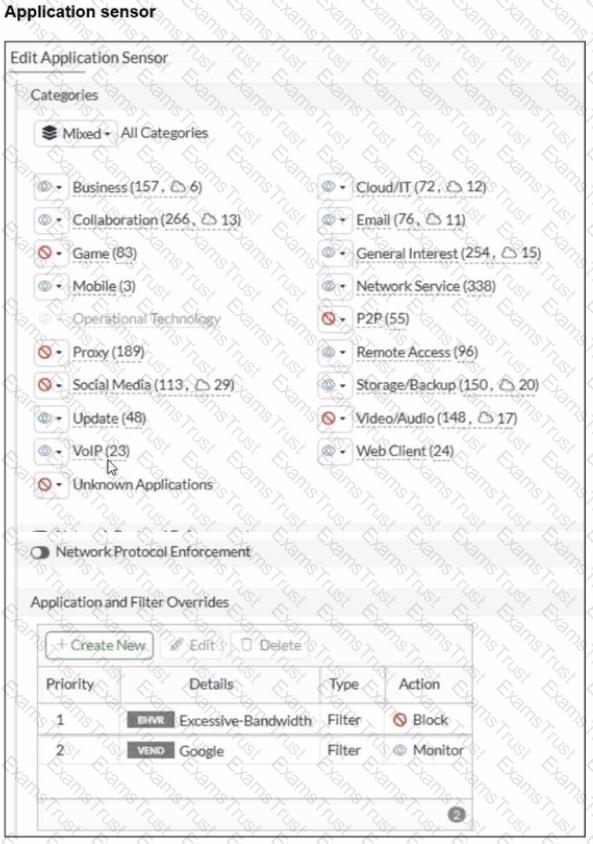
Refer to the exhibits.

You have implemented the application sensor and the corresponding firewall policy as shown in the exhibits.

Which two factors can you observe from these configurations? (Choose two.)

Options:

A.

YouTube access is blocked based on Excessive-Bandwidth Application and Filter override settings.

B.

Facebook access is blocked based on the category filter settings.

C.

Facebook access is allowed but you cannot play Facebook videos based on Video/Audio category filter settings.

D.

YouTube search is allowed based on the Google Application and Filter override settings.

Question 8

Which two components are part of the secure internet access (SIA) agent-based mode on FortiSASE? (Choose two.)

Options:

A.

FortiSASE Firewall-as-a-Service (FWaaS)

B.

The proxy auto-configuration (PAC) file

C.

VPN policies

D.

FortiExtender

Question 9

Refer to the exhibit.

As an administrator you have created an IPS profile, but it is not performing as expected. While testing you got the output as shown in the exhibit What could be the possible reason of the diagnose output shown in the exhibit?

Options:

A.

There is a no firewall policy configured with an IPS security profile.

B.

Administrator entered the command diagnose test application ipsmonitor 5.

C.

FortiGate entered into IPS fail open state.

D.

Administrator entered the command diagnose test application ipsmonitor 99.

Question 10

Which two statements describe characteristics of automation stitches? (Choose two answers)

Options:

A.

Actions involve only devices included in the Security Fabric.

B.

An automation stitch can have multiple triggers.

C.

Multiple actions can run in parallel.

D.

Triggers can involve external connectors.

Question 11

Refer to the exhibit.

A RADIUS server configuration is shown.
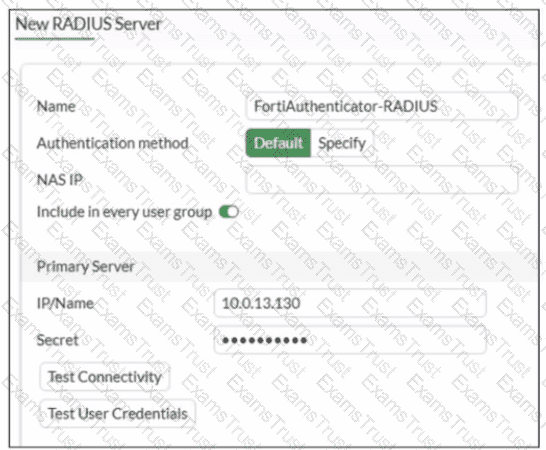
An administrator added a configuration for a new RADIUS server While configuring, the administrator enabled Include in every user group What is the impact of enabling Include in every user group in a RADIUS configuration?

Options:

A.

This option places the RADIUS server, and all users who can authenticate against that server, into every FortiGate user group.

B.

This option places all FortiGate users and groups required to authenticate into the RADIUS server, which, in this case, is FortiAuthenticator.

C.

This option places the RADIUS server, and all users who can authenticate against that server, into every RADIUS group.

D.

This option places all users into every RADIUS user group, including groups that are used for the LDAP server on FortiGate.

Question 12

Which two statements are true about an HA cluster? (Choose two answers)

Options:

A.

An HA cluster cannot have both in-band and out-of-band management interfaces at the same time.

B.

Link failover triggers a failover if the administrator sets the interface down on the primary device.

C.

When sniffing the heartbeat interface, the administrator must see the IP address 169.254.0.2.

D.

HA incremental synchronization includes FIB entries and IPsec SAs.

Question 13

You have configured an application control profile, set peer-to-peer traffic to Block under the Categories tab. and applied it to the firewall policy. However, your peer-to-peer traffic on known ports is passing through the FortiGate without being blocked.

What FortiGate settings should you check to resolve this issue?

Options:

A.

FortiGuard category ratings

B.

Network Protocol Enforcement

C.

Replacement Messages for UDP-based Applications

D.

Application and Filter Overrides

Question 14

Refer to the exhibit.

The administrator configured SD-WAN rules and set the FortiGate traffic log page to display SD-WAN-specific columns: SD-WAN Quality and SD-WAN Rule Name

FortiGate allows the traffic according to policy ID 1 placed at the top. This is the policy that allows SD-WAN traffic. Despite these settings, the traffic logs do not show the name of the SD-WAN rule used to steer those traffic flows

What could be the reason?

Options:

A.

SD-WAN rule names do not appear immediately. The administrator must refresh the page.

B.

There is no application control profile applied to the firewall policy.

C.

Destinations in the SD-WAN rules are configured for each application, but feature visibility is not enabled.

D.

FortiGate load balanced the traffic according to the implicit SD-WAN rule.

Question 15

Refer to the exhibit.

Which two ways can you view the log messages shown in the exhibit? (Choose two.)

Options:

A.

By right clicking the implicit deny policy

B.

Using the FortiGate CLI command diagnose log test

C.

By filtering by policy universally unique identifier (UUID) and application name in the log entry

D.

In the Forward Traffic section

Question 16

There are multiple dialup IPsec VPNs configured in aggressive mode on the HQ FortiGate. The requirement is to connect dial-up users to their respective department VPN tunnels.

Which phase 1 setting you can configure to match the user to the tunnel?

Options:

A.

Local Gateway

B.

Dead Peer Detection

C.

Peer ID

D.

IKE Mode Config

Question 17

An administrator wants to configure dead peer detection (DPD) on IPsec VPN for detecting dead tunnels. The requirement is that FortiGate sends DPD probes only when there is no inbound traffic.

Which DPD mode on FortiGate meets this requirement?

Options:

A.

On Demand

B.

Enabled

C.

On Idle

D.

Usabled

Question 18

You have created a web filter profile named restrictmedia-profile with a daily category usage quota.

When you are adding the profile to the firewall policy, the restrict_media-profile is not listed in the available web profile drop down.

What could be the reason?

Options:

A.

The web filter profile is already referenced in another firewall policy.

B.

The firewall policy is in no-inspection mode instead of deep-inspection.

C.

The naming convention used in the web filter profile is restricting it in the firewall policy.

D.

The inspection mode in the firewall policy is not matching with web filter profile feature set.