
Spring Sale Limited Time 70% Discount Offer - Ends in 0d 00h 00m 00s - Coupon code: 70special

F5 F5CAB4 BIG-IP Administration Control Plane Administration (F5CAB4) exam Exam Practice Test

Page: 1 / 7
Total 67 questions

BIG-IP Administration Control Plane Administration (F5CAB4) exam Questions and Answers

Testing Engine

  • Product Type: Testing Engine
$37.5  $124.99

PDF Study Guide

  • Product Type: PDF Study Guide
$33  $109.99
Question 1

A BIG-IP Administrator needs to restore a UCS file to an F5 device using the Configuration Utility. Which section of the Configuration Utility should the BIG-IP Administrator access to perform this task?

Options:

A.

Local Traffic > Virtual Servers

B.

Local Traffic > Policies

C.

System > Archives

D.

System > Configuration

Question 2

Which TMSH command initiates a manual configuration synchronization to the specified device group? (Choose one answer)

Options:

A.

tmsh load sys config to-group

B.

tmsh modify sys failover auto-sync enable

C.

tmsh run cm config-sync to-group

D.

tmsh run sys device-group update-config

Question 3

The BIG-IP system is provisioned for LTM only. The BIG-IP Administrator is tasked with provisioning ASM.

What process restarts when the BIG-IP Administrator changes the module provisioning? (Choose one answer)

Options:

A.

bd

B.

tmm

C.

sshd

D.

httpd

Question 4

A configuration change is made on the standby member of a device group. What is displayed as "Recommended Action" on the Device Management Overview screen?

Options:

A.

Force active member of device group to standby

B.

Activate device with the most recent configuration

C.

Synchronize the active member configuration to the group.

D.

Synchronize the standby member configuration to the group

Question 5

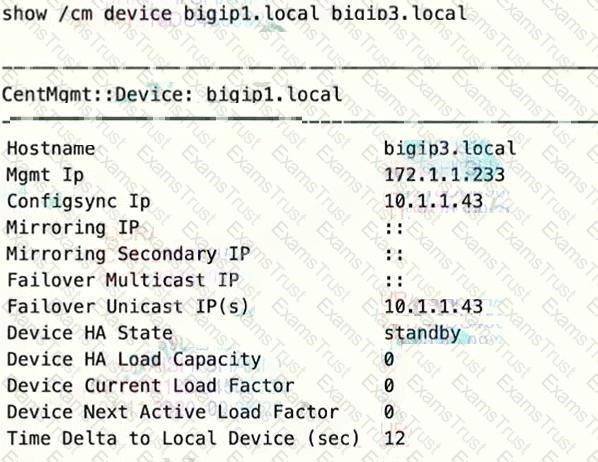
Refer to the exhibit.

The BIG-IP Administrator runs the command shown and observes a device trust issue between BIG-IP devices in a device group. The issue prevents config sync on device bigip3.local. What is preventing the config sync?

Options:

A.

Next Active Load factor is 0 on bigip1.local

B.

Both devices are standby

C.

Next Active Load factor is 1 on bigip1.local

D.

Time Delta to local system is

Question 6

A BIG-IP Administrator must determine if a Virtual Address is configured to fail over to the standby member of a device group. In which area of the Configuration Utility can this be confirmed?

Options:

A.

Device Management > Traffic Groups

B.

Device Management > Devices34

C.

Local Traffic > Virtual Servers35

D.

Device Management > Overview36

Question 7

A BIG-IP Administrator needs to fall over the active device. The administrator logs into the Configuration Utility and navigates to Device Management > Traffic Group. However, "Force to Standby" is greyed out. What is causing this issue?

Options:

A.

The BIG-IP Administrator is NOT logged into command line to tail over

B.

The BIG-IP Administrator is on the Standby Device

C.

The BIG-IP Administrator is logged in as root

D.

The BIG-IP Administrator is logged in as administrator

Question 8

An organization is performing a major release upgrade to its BIG-IP system. The system is under medium load and has enough disk space to perform the upgrade.

Which pre-upgrade task is disruptive to regular system performance and should be performed during a maintenance window? (Choose one answer)

Options:

A.

Create a QKView

B.

Reactivate the license

C.

tmsh save sys config

D.

Generate a UCS

Question 9

A BIG-IP Administrator needs to update the license on a BIG-IP device. Where can this be done?

Options:

A.

System > Software Management

B.

System > License

C.

System > Platform

D.

Device Management

Question 10

What can the BIG-IP Administrator do when restoring BIG-IP configuration files with a UCS archive? (Choose two answers)

Options:

A.

The BIG-IP Administrator can only restore the UCS archive to the same system from which it was saved.

B.

The BIG-IP Administrator can restore a UCS archive on a BIG-IP system running a later software version than the version of software the UCS archive was created on.

C.

The BIG-IP Administrator can restore a UCS archive on a BIG-IP system on a different platform.

D.

The BIG-IP Administrator can only restore a UCS archive on a BIG-IP system running the same version.

Question 11

A BIG-IP Administrator finds the following log entry: tnm tmm[7141]: 011e0002:4: sweeper_update: aggressive mode activated. Which action should the BIG-IP Administrator take to mitigate this memory issue?

Options:

A.

Configure the redundant pair to be active-active

B.

Decrease the TCP profile Idle Timeout value

C.

Increase the TCP profile Idle Timeout value

D.

Configure the server to use Connection Mirroring

Question 12

A BIG-IP Administrator plans to resolve a non-critical issue with a BIG-IP device in 2 weeks. What Severity level should be assigned to this type of F5 support ticket?

Options:

A.

4

B.

2

C.

3

D.

1

Question 13

A BIG-IP Administrator needs to check the memory utilization on a BIG-IP system. Which two methods can the BIG-IP Administrator use? (Choose two.)

Options:

A.

Run the tmsh show /sys memory command

B.

Run the tmsh show /sys traffic command

C.

Go to Statistics > Module Statistics > Traffic Summary in the configuration utility

D.

Go to Statistics > Module Statistics > Memory in the configuration utility

Question 14

Which command will provide the BIG-IP Administrator with the current device HA status? (Choose one answer)

Options:

A.

list /cm failover

B.

show /sys failover

C.

show /cm failover-status

Question 15

The BIG-IP Administrator has modified an iRule on one device of an HA pair. The BIG-IP Administrator notices there is NO traffic on the BIG-IP device in which they are logged into. What should the BIG-IP Administrator do to verify if the iRule works correctly?

Options:

A.

Push configuration from this device to the group and start to monitor traffic on this device

B.

Pull configuration to this device to the cluster and start to monitor traffic on this device

C.

Log in to the other device in the cluster, push configuration from it, and start to monitor traffic on that device

D.

Log in to the other device in the cluster, pull configuration to it, and start to monitor traffic on that device

Question 16

A node is a member of various pools and hosts different web applications. If a web application is unavailable, the BIG-IP appliance needs to mark the pool member down for that application pool. What should a BIG-IP Administrator deploy at the pool level to accomplish this?

Options:

A.

A combination of ICMP + TCP monitor

B.

A TCP monitor with a custom interval/timeout

C.

A UDP monitor with a custom interval/timeout

D.

An HTTP monitor with custom send/receive strings

Question 17

A BIG-IP Administrator is setting up a new BIG-IP device. The network administrator reports that the interface has an incompatible media speed. The BIG-IP Administrator needs to change this setting manually. From which location should the BIG-IP Administrator perform this task?14

Options:

A.

On the Front Console15

B.

In the TMOS Shell Command line16

C.

In the Configuration Utility, Network > Interface17

D.

In the Configuration Utility, System > Configuration18

Question 18

Which log file should the BIG-IP Administrator check to determine if a specific user tried to log in to the BIG-IP Configuration Utility? (Choose one answer)

Options:

A.

/var/log/pam/tallylog

B.

/var/log/secure

C.

/var/log/ltm

D.

/var/log/httpd

Question 19

The BIG-IP Administrator suspects unauthorized SSH login attempts on the BIG-IP system.

Which log file would contain details of these attempts? (Choose one answer)

Options:

A.

/var/log/messages

B.

/var/log/secure

C.

/var/log/audit

D.

/var/log/ltm

Question 20

The BIG-IP Administrator runs the command:

netstat -an | grep 443

and sees the following output:

tcp 0 0 0.0.0.0:443 0.0.0.0:* LISTEN

What does this output indicate about the service on port 443? (Choose one answer)

Options:

A.

The service is actively listening only on the loopback interface.

B.

The service is actively listening on all interfaces for HTTPS traffic.

C.

The service indicates no connections to the LISTEN port.

D.

The service is in a standby state and unable to accept connections.

Page: 1 / 7
Total 67 questions