
Spring Sale Limited Time 70% Discount Offer - Ends in 0d 00h 00m 00s - Coupon code: 70special

F5 F5CAB3 BIG-IP Administration Data Plane Configuration (F5CAB3) exam Exam Practice Test

Page: 1 / 7
Total 74 questions

BIG-IP Administration Data Plane Configuration (F5CAB3) exam Questions and Answers

Testing Engine

  • Product Type: Testing Engine
$37.5  $124.99

PDF Study Guide

  • Product Type: PDF Study Guide
$33  $109.99
Question 1

A BIG-IP Administrator finds the following log entry after a report of user issues connecting to a virtual server:

01010201: Intercept exhaustion on 10.70.110.112 to 192.28.123.250:80 (proto 6)

How should the BIG-IP Administrator modify the SNAT pool that is associated with the virtual server? (Choose one answer)

Options:

A.

Increase the timeout of the SNAT addresses

B.

Remove the SNAT pool and apply SNAT Automap

C.

Remove an IP address from the SNAT pool

D.

Add an IP address to the SNAT pool

Question 2

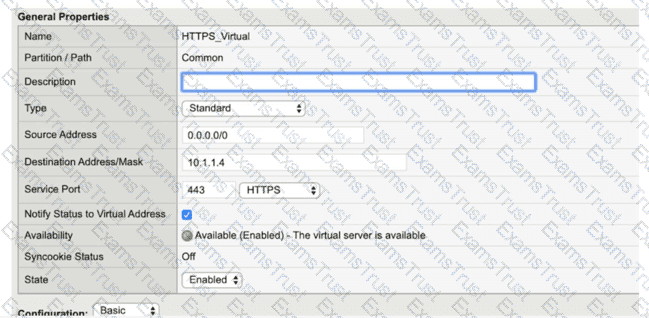
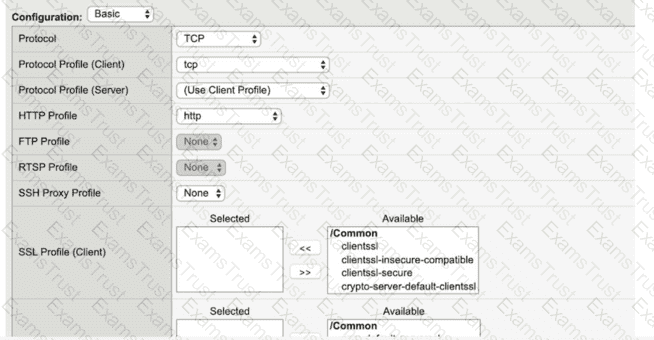
Refer to the exhibit.

A BIG-IP Administrator configures a Virtual Server to handle HTTPS traffic. Users report that the application is NOT working. Which additional configuration is required to resolve this issue?

Options:

A.

Configure SSL Profile (Client)

B.

Configure Protocol Profile (Server)

C.

Configure SSL Profile (Server)

D.

Configure Service Port to HTTP

Question 3

All pool members are online. All other virtual server settings are at default.

What might alter the load balancing behavior? (Choose one answer)

Options:

A.

Adding a OneConnect profile

B.

Enabling SNAT automap

C.

Enabling a fallback host in the HTTP profile

D.

Adding a persistence profile

Question 4

For a given Virtual Server, the BIG-IP must perform SSL Offload and negotiate secure communication over TLSv1.2 only. What should the BIG-IP Administrator do to meet this requirement?

Options:

A.

Configure a custom SSL Profile (Client) with a custom TLSv1.2 cipher string

B.

Configure a custom SSL Profile (Server) and select no TLSv1 in the options list

C.

Configure a custom SSL Profile (Server) with a custom TLSv1.2 cipher string

D.

Configure a custom SSL Profile (Client) and select no TLSv1 in the options list

Question 5

A BIG-IP Administrator adds new pool members to a highly utilized pool. The application begins failing.

What pool-level setting should be checked?

Options:

A.

Availability Requirement

B.

Allow SNAT

C.

Action On Service Down

D.

Slow Ramp Time

Question 6

The BIG-IP Administrator has to provide encrypted communication between the users and the virtual server they access. Multiple hostnames are configured in DNS with the same IP address. Which profile type and setting in the profile should be used? (Choose one answer)

Options:

A.

Client SSL, Client Name

B.

Server SSL, Server Name

C.

Client SSL, Server Name

D.

Server SSL, Client Name

Question 7

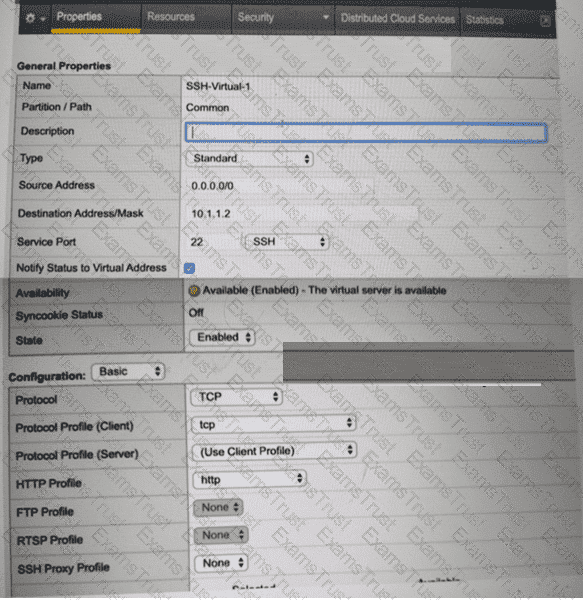
Refer to the exhibit.

A BIG-IP Administrator creates a new Virtual Server to load balance SSH traffic. Users are unable to log on to the servers.

What should the BIG-IP Administrator do to resolve the issue? (Choose one answer)

Options:

A.

Set Protocol to UDP

B.

Set Source Address to 10.1.1.2

C.

Set Destination Address/Mask to 0.0.0.0/0

D.

Set HTTP Profile to None

Question 8

All pool members are online. All other virtual server settings are at default. What might alter the load balancing behavior?

Options:

A.

Adding a oneconnect profile

B.

Adding a persistence profile

C.

Enabling a fallback host in the http profile

D.

Enabling SNAT automap

Question 9

Where in the configuration utility should the BIG-IP Administrator verify the pool member currently assigned to a pool is on port 80?

Options:

A.

Local Traffic > Nodes: Node List. Select the node in question, view the Health Monitor next to Configuration.

B.

Local Traffic > Pools: Pool List. Select the pool in question, select Members tab, view the configured Health Monitor.

C.

Local Traffic > Pools: Pool List. Select the pool in question, select the Members tab, view the configured Service Port.

Question 10

The BIG-IP Administrator is investigating if better TCP performance is possible for a virtual server. Which built-in profile should be tried first?

Options:

A.

f5-tcp-legacy

B.

f5-tcp-mobile

C.

f5-tcp-progressive

D.

f5-tcp-wan

Question 11

A Standard Virtual Server for a web application is configured with Automap for the Source Address Translation option. The original source address of the client must be known by the backend servers. What should the BIG-IP Administrator configure to meet this requirement?

Options:

A.

The Virtual Server type as Performance (HTTP)

B.

An HTTP profile to insert the X-Forward-For header

C.

A SNAT Pool with the client IP

D.

An HTTP Transparent profile

Question 12

Application administrators are reporting that nodes different from those configured in the pool are selected. The use of an iRule is suspected.

How can the BIG-IP Administrator check if an iRule is used for this traffic? (Choose two answers)

Options:

A.

Via TMSH with the list /ltm rule command.

B.

Via the GUI at the Resources tab for the virtual server.

C.

Via TMSH with the list /ltm virtual command.

D.

Via the GUI at the iRule tab for the virtual server.

Question 13

A BIG-IP Administrator configures an SSH pool with five members.

Which health monitor should be applied?

Options:

A.

HTTPS

B.

UDP

C.

HTTP

D.

TCP

Question 14

The BIG-IP Administrator is investigating whether better TCP performance is possible for a virtual server.

Which built-in profile should be tried first? (Choose one answer)

Options:

A.

f5-tcp-legacy

B.

f5-tcp-progressive

C.

f5-tcp-mobile

D.

No option

Question 15

A BIG-IP Administrator configures a node with a standard icmp Health Monitor. The Node shows as DOWN although the Backend Server is configured to answer ICMP requests. Which step should the administrator take next to find the root cause of this issue?

Options:

A.

Run a qkview

B.

Run a tcpdump

C.

Run an ssldump

D.

Run a curl

Question 16

A configuration change is made on the standby member of a device group. What is displayed as "Recommended Action" on the Device Management Overview screen?

Options:

A.

Force active member of device group to standby

B.

Activate device with the most recent configuration

C.

Synchronize the active member configuration to the group

D.

Synchronize the standby member configuration to the group

Question 17

DNS queries from internal DNS servers fail when sent through a BIG-IP Virtual Server.

Which Virtual Server property should be changed?

Options:

A.

Protocol Profile (Client) to DNS_OPTIMIZED

B.

Type to Performance (HTTP)

C.

Protocol to UDP

D.

Source Address to subnet

Question 18

A BIG-IP Administrator creates a new Virtual Server to load balance SSH traffic. Users are unable to log on to the servers.

What should the BIG-IP Administrator do to resolve the issue?

Options:

A.

Set Protocol to UDP

B.

Set HTTP Profile to None

C.

Set Source Address to 10.1.1.2

D.

Set Destination Address/Mask to 0.0.0.0/0

Question 19

During high-demand traffic events, the BIG-IP Administrator needs to limit new connections per second.

What should be applied?

Options:

A.

HTTP Compression profile

B.

Connection rate limit

C.

Connection limit

D.

OneConnect profile

Question 20

A BIG-IP Administrator configures a Virtual Server to load balance traffic between 50 webservers for an ecommerce website. Traffic is being load balanced using the Least Connections (node) method. The webserver administrators report that customers are losing the contents from their shopping carts and are unable to complete their orders. What should the BIG-IP Administrator do to resolve the issue?

Options:

A.

Change Default Persistence Profile setting to cookie

B.

Change Default Persistence Profile setting to sip_info

C.

Change Load Balancing method to Ratio (node)

D.

Change Load Balancing method to Ratio (member)

Question 21

A BIG-IP Administrator finds the following log entry: tmm tmm[714]: 011e0002:4: sweeper_update: aggressive mode activated. Which action should the BIG-IP administrator take to mitigate this memory issue?

Options:

A.

Configure the redundant pair to be active-active

B.

Decrease the TCP profile Idle Timeout value

C.

Increase the TCP profile Idle Timeout value

D.

Configure the virtual server to use Connection Mirroring

Question 22

A BIG-IP Administrator adds new pool members into an existing, highly utilized pool. Soon after, there are reports that the application is failing to load for some users.

What pool-level setting should the BIG-IP Administrator check?

Options:

A.

Availability Requirement

B.

Allow SNAT

C.

Action On Service Down

D.

Slow Ramp Time

Page: 1 / 7
Total 74 questions