

What type of virtual server has a destination of 0.0.0.0 and listens on a specific VLAN? (Choose one answer)
A BIG-IP Administrator needs to apply a health monitor for a pool of database servers named DB_Pool that uses TCP port 1521. Where should the BIG-IP Administrator apply this monitor?
A BIG-IP Administrator configures remote authentication and needs to ensure that users can still log in even when the remote authentication server is unavailable. Which action should the BIG-IP Administrator take in the remote authentication configuration to meet this requirement? (Choose one answer)
A BIG-IP Administrator needs to connect a BIG-IP system to two upstream switches to provide external network resilience. The network engineer instructs the administrator to configure interface binding with LACP. Which configuration should the administrator use? (Choose one answer)
Which three iRule events are likely to be seen in iRules designed to select a pool for load balancing? (Choose three.)
A BIG-IP system receives a client connection destined to 1.0.0.10:8080. Multiple virtual servers are configured on the system. Which virtual server will process the connection? (Choose one answer)
The diagram below shows the TCP connection setup for an application.
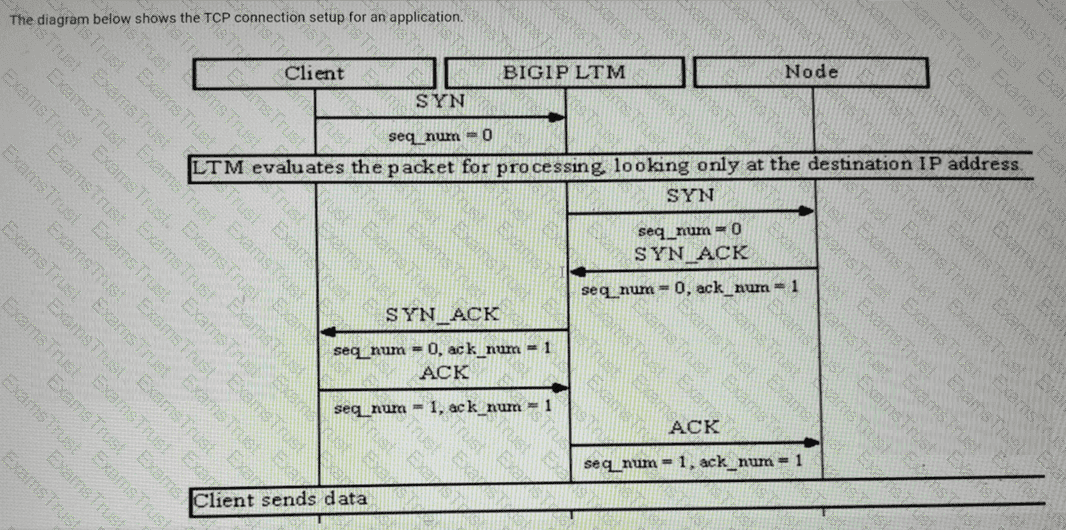
Which of the following virtual server types applies? (Choose one answer)
An organization needs to deploy an HTTP application on a BIG-IP system. The requirements specify hardware acceleration to enhance performance, while HTTP optimization features are not required.
What type of virtual server and associated protocol profile should be used to meet these requirements? (Choose one answer)
Which of the following lists the order of preference from most preferred to least preferred when BIG-IP processes and selects a virtual server? (Choose one answer)
The BIG-IP appliance fails to boot. The BIG-IP Administrator needs to run the End User Diagnostics (EUD) utility to collect data to send to F5 Support. Where can the BIG-IP Administrator access this utility?
What should a BIG-IP Administrator configure to minimize impact during a failover? (Choose one answer)
The BIG-IP Administrator wants to provide quick failover between the F5 LTM devices that are configured as an HA pair with a single Self IP using the MAC Masquerade feature. The administrator configures MAC masquerade for traffic-group-1 using the following command:
`tmsh modify /cm traffic-group traffic-group-1 mac 02:12:34:56:00:00`
However, the Network Operations team identifies an issue with using the same MAC address across multiple VLANs. As a result, the administrator enables Per-VLAN MAC Masquerade to ensure a unique MAC address per VLAN by running:
`tmsh modify /sys db tm.macmasqaddr_per_vlan value true`
What would be the resulting MAC address on a tagged VLAN with ID 1501? (Choose one answer)