
Spring Sale Limited Time 70% Discount Offer - Ends in 0d 00h 00m 00s - Coupon code: 70special

Cisco 300-220 Conducting Threat Hunting and Defending using Cisco Technologies for Cybersecurity 300-220 CBRTHD Exam Practice Test

Page: 1 / 6
Total 60 questions

Conducting Threat Hunting and Defending using Cisco Technologies for Cybersecurity 300-220 CBRTHD Questions and Answers

Testing Engine

  • Product Type: Testing Engine
$42  $139.99

PDF Study Guide

  • Product Type: PDF Study Guide
$36  $119.99
Question 1

A SOC team using Cisco security technologies wants to distinguishIndicators of Attack (IOAs)fromIndicators of Compromise (IOCs)during threat hunting. Which scenario BEST represents an IOA rather than an IOC?

Options:

A.

Detection of a known malicious file hash on an endpoint

B.

Identification of a domain listed in a threat intelligence feed

C.

Observation of repeated failed logins followed by a successful login from a new location

D.

Blocking an IP address associated with previous malware campaigns

Question 2

A threat hunting team wants to ensure hunts are repeatable, scalable, and less dependent on individual analyst intuition. What is the MOST important process improvement?

Options:

A.

Increasing the number of threat intelligence feeds

B.

Automating alert triage workflows

C.

Standardizing hunt documentation and hypotheses

D.

Blocking all suspicious activity automatically

Question 3

A threat hunting team is attempting to attribute a series of intrusions across multiple organizations to a known threat actor. The malware binaries differ across incidents, infrastructure changes frequently, and IP addresses rotate daily. Which evidence provides the STRONGEST basis for confident attribution?

Options:

A.

Overlapping IP address ranges used during attacks

B.

Similar malware filenames and hashes

C.

Consistent attacker tradecraft mapped to MITRE ATT&CK

D.

Identical timestamps of attack activity

Question 4

A threat hunter is asked to model how an attacker could abuse cloud identity misconfigurations to escalate privileges without exploiting software vulnerabilities. Which modeling approach BEST supports this analysis?

Options:

A.

STRIDE focused on spoofing and elevation of privilege

B.

Kill Chain analysis focused on malware execution

C.

Attack path analysis using identity relationships

D.

CVSS scoring of IAM misconfigurations

Question 5

Refer to the exhibit.

An analyst is evaluating artifacts and logs collected from recent breach. In the logs, ATP established persistency of malware by placing a path to the executable in a specific registry entry. What is the difference between the ATP's approach and using HKEY LOCAL MACHINE\Software\Microsoft\Windows\CurrentVersion\Run instead?

Options:

A.

The key is available only on older versions of Windows and is not supported in newer ones.

B.

Entries in this key are automatically removed after a system restart, which prevents persistence.

C.

Modifying this key requires administrative privileges, which the malware might not have.

D.

This key is meant for system settings and not for storing startup program entries.

Question 6

Refer to the exhibit.

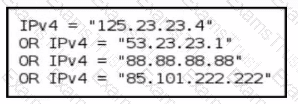
A threat-hunting team makes an EDR query to detect possible C2 outbound communication across all endpoints. Which level of the Pyramid of Pain is being used?

Options:

A.

Tough

B.

Challenging

C.

Easy

D.

Simple

Question 7

A threat hunter wants to detect fileless malware activity usingCisco Secure Endpoint. Which behavior would MOST strongly indicate fileless execution?

Options:

A.

Executables running from Program Files

B.

Processes spawning from user-writable directories

C.

Legitimate system processes executing encoded commands

D.

Files with unknown hash reputation

Question 8

The security team detects an alert regarding a potentially malicious file namedFinancial_Data_526280622.pdfdownloaded by a user. Upon reviewing SIEM logs and Cisco Secure Endpoint, the team confirms that the file was obtained from an untrusted website. The hash analysis of the file returns an unknown status. Which action must be done next?

Options:

A.

Submit the file for sandboxing.

B.

Review the directory path where the file is stored.

C.

Run a complete malware scan on the user's workstation.

D.

Investigate the reputation of the untrusted website.

Question 9

During multiple intrusions, analysts observe that attackers consistently perform internal reconnaissance before privilege escalation, avoid noisy exploitation, and limit actions to business hours of the victim’s region. Why is this observation important for attribution?
Options:

A.

It confirms the use of a specific exploit kit

B.

It indicates an advanced persistence mechanism

C.

It reveals operational discipline and intent

D.

It identifies the malware command-and-control protocol

Question 10

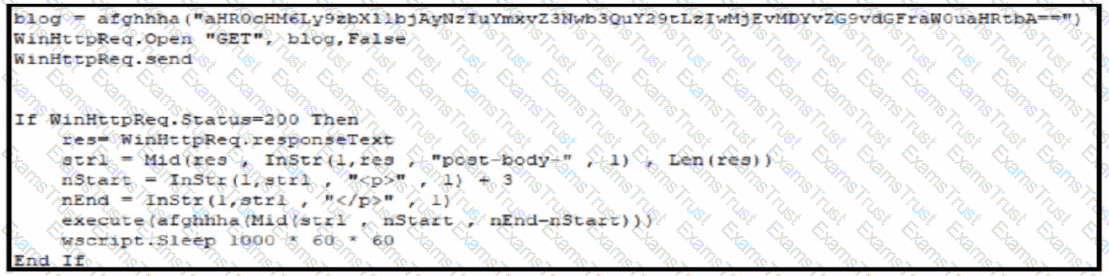
Refer to the exhibit. Which technique is used by the attacker?

Options:

A.

Perform a preliminary check to verify if the victim has already been compromised.

B.

Scan using a batch file created on the fly that contains the command.

C.

Use a base64-encoded VBScript that is decoded and executed on the endpoint.

D.

Set up persistence by creating a shortcut for the malicious macro in the user's Startup directory

Question 11

A threat hunter usesCisco Secure Network Analytics (Stealthwatch)to identify potential command-and-control traffic. Which characteristic MOST strongly indicates beaconing behavior?
Options:

A.

Large file transfers to external IP addresses

B.

Irregular outbound connections over multiple protocols

C.

Small, periodic outbound connections to a rare destination

D.

High-volume inbound traffic from the internet

Question 12

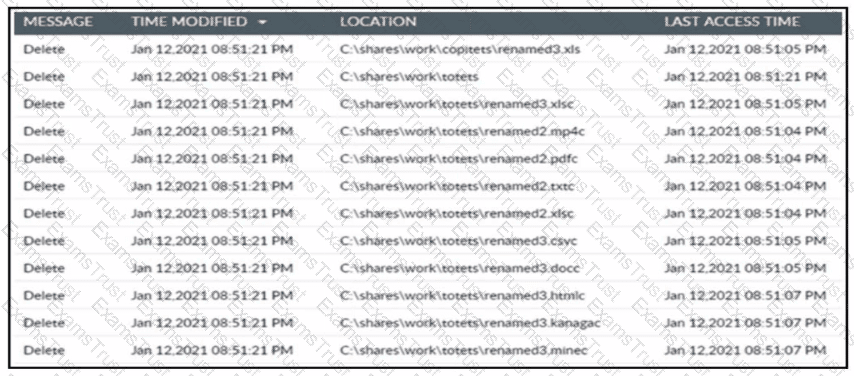
Refer to the exhibit. A cybersecurity team receives an alert from its Intrusion Prevention System about multiple file changes to a file server. Before the changes were made, the team detected a successful remote sign-in from a user account to the server. Which type of threat occurred?

Options:

A.

white box penetration test

B.

authorized penetration test

C.

unauthorized penetration test

D.

black box penetration test

Question 13

A threat hunter completes a structured hunt and confirms malicious lateral movement within the environment. Which action BEST ensures the hunt contributes to long-term defensive improvement?

Options:

A.

Escalating the incident to executive leadership

B.

Resetting credentials for all affected users

C.

Documenting findings and updating detection logic

D.

Continuing to monitor the activity for additional evidence

Question 14

Refer to the exhibit.

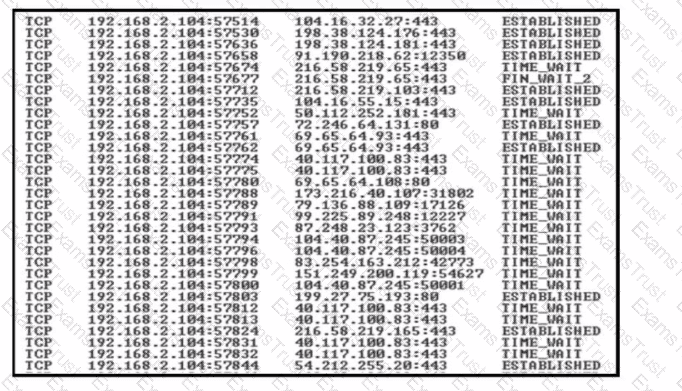
A security team detects a spike in traffic from the company web server. After further investigation, the team discovered that multiple connections have been established from the server to different IP addresses, but the web server logs contain both expected traffic and DDoS traffic. Which attribute must the team use to further filter the logs?

Options:

A.

connection status

B.

destination port

C.

IP address of the web server

D.

protocol

Question 15

A security analyst receives an alert that host A, which has an IP address of 192.168.5.39, has a new browser extension installed. During an investigation of the SIEM tool logs, the analyst discovers that host A made continuous TCP connections to an IP address of 1.25.241.8 via TCP port 80. The 1.25.241.8 IP address is categorized as a C2 server. Which action should the analyst take to mitigate similar connections in the future?

Options:

A.

Configure a browser extension deny list.

B.

Use antivirus software to quarantine suspicious files automatically.

C.

Use Deep Packet Inspection to block malicious domains.

D.

Use IDS to detect and avoid similar connections.

Question 16

Refer to the exhibit.

A company recently was breached and decided to improve their security posture going forward. A security assessment was ordered, specifically intended to test weak points exploited during the breach. A security analyst reviews server logs to identify activities related to the aforementioned security assessment. Which entry suggests a delivery method associated with authorized assessment?

Options:

A.

Login test at scale using "AuthCheck/4.1" and leaked credentials.

B.

Using "SecurityScan/2.5" to access all /admin endpoints.

C.

Exploitation via "ExploitTest/2.0" using a shutdown command.

D.

Scan via "WebCrawler/1.0" to gather public-facing information.

Question 17

A SOC manager wants to evaluate whether the organization’s Cisco-based threat hunting program is improving over time. Which metric BEST reflects increased threat hunting effectiveness?

Options:

A.

Number of alerts generated by Cisco security tools

B.

Reduction in attacker dwell time

C.

Number of blocked IP addresses

D.

Volume of threat intelligence feeds consumed

Question 18

A Cisco-focused SOC wants to move detection coverage higher on thePyramid of Pain. Which hunting outcome BEST supports this objective?

Options:

A.

Blocking known malicious domains using Cisco Secure Web Appliance

B.

Detecting abnormal authentication behavior across VPN and cloud access

C.

Creating alerts for malware hashes from Talos feeds

D.

Quarantining infected endpoints automatically

Page: 1 / 6
Total 60 questions