

Weekend Sale Limited Time 70% Discount Offer - Ends in 0d 00h 00m 00s - Coupon code: 70special

ARDMS AE-Adult-Echocardiography AE Adult Echocardiography Examination Exam Practice Test

AE Adult Echocardiography Examination Questions and Answers

Testing Engine

  • Product Type: Testing Engine
$37.5  $124.99

PDF Study Guide

  • Product Type: PDF Study Guide
$33  $109.99
Question 1

A continuous flow murmur is most likely due to which abnormality?

Options:

A.

Ventricular septal defect

B.

Patent ductus arteriosus

C.

Concomitant aortic stenosis and mitral regurgitation

D.

Ebstein anomaly with atrial septal defect

Question 2

Which coronary artery territory is associated with the wall motion abnormality demonstrated in this video?
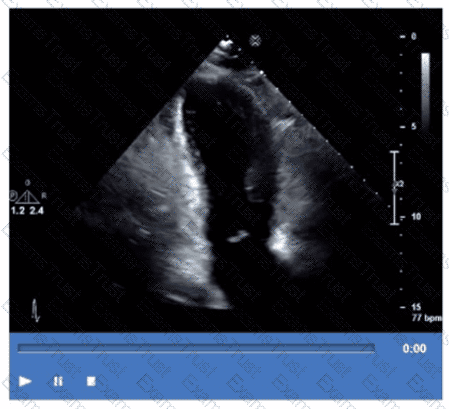
Options:

A.

Right

B.

Left circumflex

C.

Left anterior descending

D.

Posterior descending

Question 3

Which hepatic vein flow pattern signals severe tricuspid regurgitation?

Options:

A.

Flow reversal in systole

B.

Flow reversal in diastole

C.

Atrial flow reversal in systole

D.

Biphasic flow reversal in diastole

Question 4

Which Doppler signal is used to calculate the pulmonary artery end-diastolic pressure gradient?

Options:

A.

Tricuspid insufficiency

B.

Tricuspid inflow velocity

C.

Pulmonary insufficiency

D.

Pulmonary inflow velocity

Question 5

A patient with a ventricular septal defect, an atrial septal defect, and a cleft mitral valve is likely to have which abnormality?

Options:

A.

Atrioventricular canal defect

B.

Ebstein anomaly

C.

Marfan syndrome

D.

Shone syndrome

Question 6

What is indicated by the arrow on this video clip?

Options:

A.

False tendon

B.

Moderator band

C.

Chiari network

D.

Eustachian valve

Question 7

Which of the following can be calculated from the peak tricuspid regurgitant velocity?

Options:

A.

Right atrial pressure

B.

Pulmonary artery diastolic pressure

C.

Mean pulmonary artery pressure

D.

Right ventricular systolic pressure

Question 8

Which pathology is consistent with the left ventricular strain pattern shown in this image?
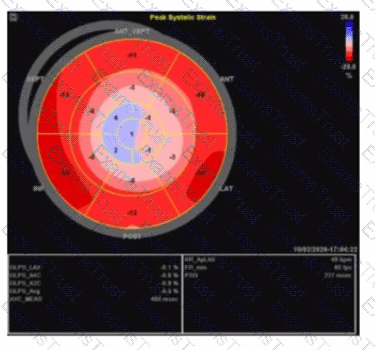
Options:

A.

Amyloidosis

B.

Apical hypertrophy

C.

Non-ischemic cardiomyopathy

D.

Right coronary artery infarct

Question 9

During which phase of the cardiac cycle does mitral valve prolapse occur?

Options:

A.

Ventricular filling

B.

Atrial systole

C.

Diastasis

D.

Ventricular contraction

Question 10

In which view is the superior vena cava visualized in its long axis?

Options:

A.

Parasternal long axis

B.

Apical five-chamber

C.

Suprasternal notch

D.

Subcostal four-chamber

Question 11

Which method is appropriate for measuring the left atrial diameter in parasternal long axis?

Options:

A.

Inner edge to inner edge, perpendicular to the aortic root, at end-diastole

B.

Inner edge to inner edge, parallel to the aortic root, at end-diastole

C.

Inner edge to inner edge, perpendicular to the aortic root, at end-systole

D.

Outer edge to outer edge, perpendicular to the aortic root, at end-systole

Question 12

Which maneuver aids in uncovering potential diastolic dysfunction while performing pulsed wave Doppler of the mitral valve?

Options:

A.

Valsalva

B.

Hand grip

C.

Leg air cycling

D.

Squatting

Question 13

Which unit of measurement is used to quantify tricuspid annular plane systolic excursion?

Options:

A.

Centimeters

B.

Centimeters/second

C.

MiHiliters/minute

D.

Millimeters of mercury

Question 14

Which type of mass is typically attached to the fossa ovalis of the left atrium?

Options:

A.

Myxoma

B.

Fibroelastoma

C.

Sarcoma

D.

Lipoma

Question 15

What is the normal dP/dt value of left ventricular systolic function?

Options:

A.

400-799 mmHg/s

B.

800-1199 mmHg/s

C.

Less than 400 mmHg/s

D.

Greater than 1200 mmHg/s

Question 16

Which region of the aorta is being measured to assess the critical finding in this image?
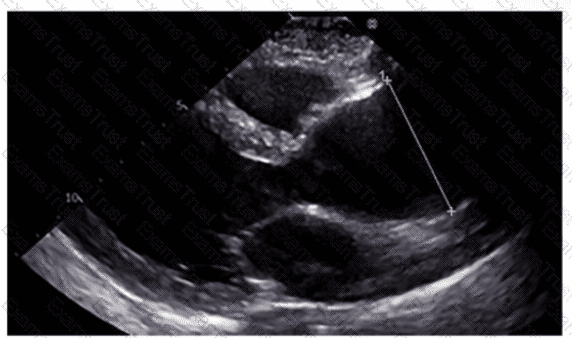
Options:

A.

Sinus of Valsalva

B.

Descending aorta

C.

Aortic root

D.

Ascending aorta

Question 17

Which of the following does the pulmonary capillary wedge pressure estimate?

Options:

A.

Left atrial pressure

B.

Right atrial pressure

C.

Left ventricular pressure

D.

Right ventricular pressure

Question 18

What minimum number of poorly-visualized contiguous left ventricular (i_V) regional wall segments indicate the use of contrast agents for LV endocardial border definition?

Options:

A.

Two

B.

Three

C.

Four

D.

Five

Question 19

Which type of defect can be seen in this video clip?
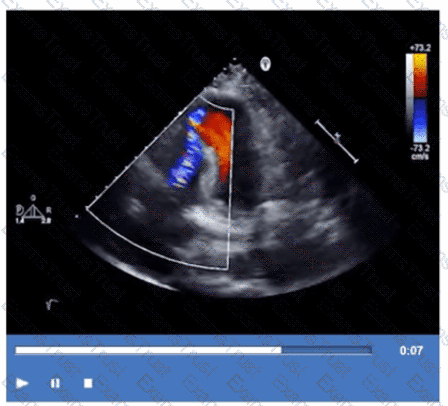
Options:

A.

Coronary artery aneurysm

B.

Tricuspid regurgitation

C.

Pseudoaneurysm of the apex

D.

Ischemic ventricular septal defect

Question 20

Which adjustment should be made to optimize this video?
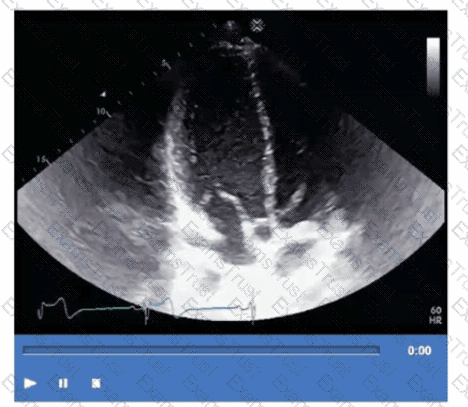
Options:

A.

Increase compression

B.

Decrease overall gain

C.

Increase time gain compensation in the near field

D.

Decrease time gain compensation in the far field

Question 21

When should the left ventricular end-diastohc diameter be measured?

Options:

A.

Onset of P wave

B.

Onset of QRS complex

C.

First frame after aortic valve closure

D.

First frame after mitral valve closure

Question 22

Which Doppler signal is most consistent with significant aortic valve regurgitation?

Options:

A.

Pulsed wave Doppler forward flow in abdominal aorta

B.

Color Doppler vena contracta / Left ventricular outflow tract diameter ratio less than 25%

C.

Continuous wave Doppler pressure half-time less than 250 ms

D.

Continuous wave Doppler peak velocity equal to or greater than 4.5 m/s

Question 23

The 'P' wave of an electrocardiogram relates to which echocardiography event?

Options:

A.

Atrial contraction

B.

Ventricular contraction

C.

Atrial relaxation

D.

Ventricular diastole

Question 24

A patient presents with tender, red lesions on their fingers and toes (Osier nodes). Which finding is most likely?

Options:

A.

Carcinoid heart disease

B.

Lambl excrescences

C.

Papillary fibroelastoma

D.

Infective endocarditis

Question 25

What can be concluded about the tricuspid valve demonstrated in this image?
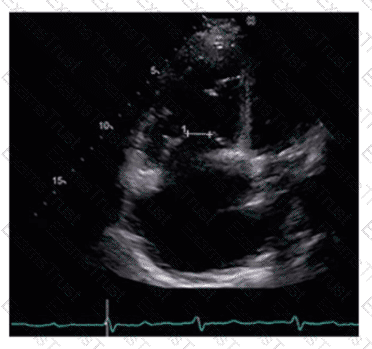
Options:

A.

Malcoaptation

B.

Normal coaptation

C.

Stenotic

D.

Endocarditis

Question 26

Which statement is considered true regarding tricuspid annular plane systolic excursion (TAPSE)?

Options:

A.

It is a measure of right ventricular diastolic function.

B.

It is an indirect measure of left ventricular systolic function.

C.

It is angle dependent.

D.

The lower reference value is 13 mm.

Question 27

Which mitral valve filling pattern is characterized by a long deceleration time and an E/A ratio of 0.6?

Options:

A.

Restrictive

B.

Pseudonormal

C.

Impaired relaxation

D.

Normal

Question 28

The parasternal long axis view can be used to visualize which anatomical structure?

Options:

A.

Coronary sinus

B.

Pulmonic valve

C.

Eustachian valve

D.

Left atrial appendage

Question 29

Which of the following occurs during the strain phase of the Valsalva maneuver?

Options:

A.

Decreased preload

B.

Decreased afterload

C.

Increased preload

D.

Increased afterload

Question 30

Which of the following is a feature of constrictive pericarditis?

Options:

A.

Mitral inflow pattern has a large E-wave and a small A-wave without respiratory changes

B.

Normal hepatic vein size

C.

Dilated inferior vena cava with inspiratory collapse during sniff test

D.

Interventricular septal bounce

Question 31

In patients with interrupted aortic arch, which structure allows Wood to flow into the descending aorta?

Options:

A.

Persistent left superior vena cava

B.

Left carotid artery

C.

Foramen ovale

D.

Patent ductus arteriosus

Question 32

What is the route of ventricular depolarization?

Options:

A.

Right bundle to left bundle branch

B.

Sinoatrial to atrioventricular nodes

C.

Bundle of His to atrioventricular node

D.

Bundle of His to Purkinje fibers

Question 33

Which measurement is indicated by the arrow on this image?
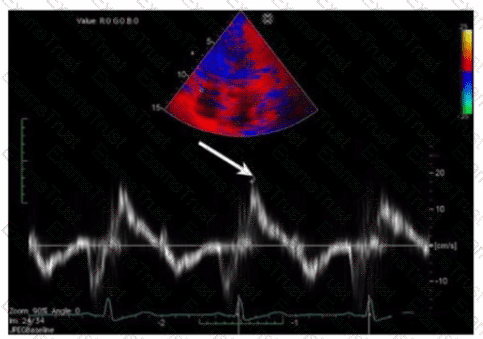
Options:

A.

S’, a measurement of right ventricular systolic function

B.

S’, a measure of right ventricular diastolic function

C.

a’, a measure of right atrial diastolic function

D.

a’, a measure of right atrial systolic function

Question 34

Which type of valvular lesion most commonly requires further evaluation with a non-imaging transducer?

Options:

A.

Aortic stenosis

B.

Mitral regurgitation

C.

Tricuspid regurgitation

D.

Pulmonic stenosis

Question 35

Acute severe aortic regurgitation leads to a marked increase in which pressure?

Options:

A.

End-diastolic

B.

End-systolic

C.

Early-diastolic

D.

Early-systolic

Question 36

Which sonographic views allow visualization of a patent ductus arteriosus (PDA)?

Options:

A.

Suprasternal notch and basal parasternal short axis

B.

Basal parasternal short axis and right ventricular inflow tract

C.

Parasternal long axis and apical long axis

D.

Parasternal long axis and apical five-chamber

Question 37

Left atrial dilation, concentric left ventricular hypertrophy, and aortic root dilation are echocardiography findings commonly associated with which condition?

Options:

A.

Restrictive cardiomyopathy

B.

Hypertrophic cardiomyopathy

C.

Pulmonary hypertension

D.

Systemic hypertension

Question 38

Which flow component is indicated by the arrows on this image?
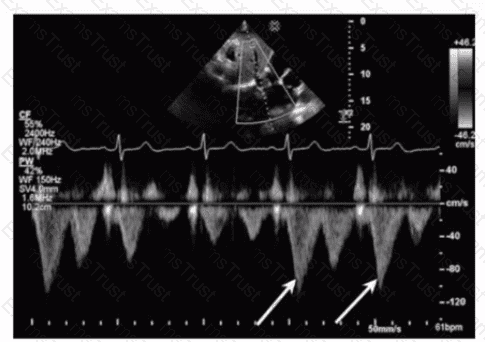
Options:

A.

Ventricular reversal

B.

Diastolic flow reversal

C.

Atrial reversal

D.

Systolic forward flow

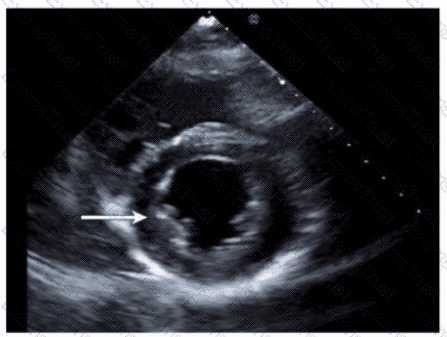
Question 39

Which wall is indicated by the arrow on this image?
Options:

A.

Anterior

B.

Inferior

C.

Anterolateral

D.

Inferolateral

Question 40

Which diagnosis is most likely confirmed by echocardiography in a 65-year-old female presenting with new onset chest pain associated with ST segment elevation on the electrocardiogram and angiographically normal coronary artenes?

Options:

A.

Alcohol-associated cardiomyopathy

B.

Apical hypertrophic cardiomyopathy

C.

Restrictive cardiomyopathy

D.

Takotsubo cardiomyopathy

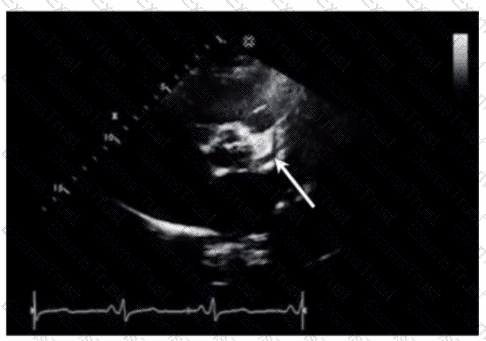
Question 41

Which coronary artery is identified by the arrow on this image?
Options:

A.

Right

B.

Left main

C.

Circumflex

D.

Left anterior descending